Four-city survey presented as Somali public opinion on foreign powers raises questions
-
 GAROWE ONLINE
- Posted On 26-08-2026, 06:21PM
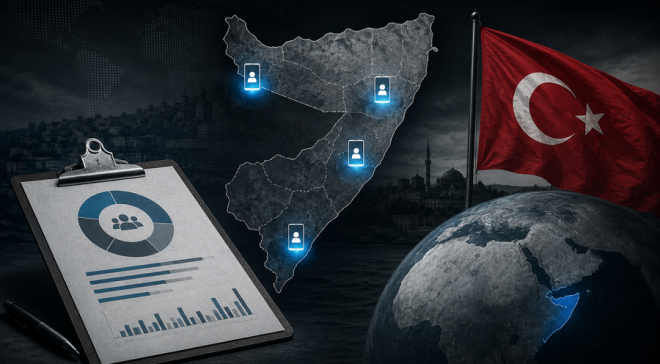
GAROWE, Somalia (Garowe Online) — An analysis presented as a measure of Somali public opinion toward foreign countries has raised questions over where the survey was conducted, how respondents were selected and the timing of its publication.
The survey was conducted by the Sababi Institute, with researcher Partha Moman publishing its findings in August under the title “Somali Public Opinion on External Powers.”
The analysis seeks to explain how Somalis view foreign countries involved in Somalia’s politics, security and economy. However, the findings are based on interviews with 1,205 people in only four cities: Marka, Jowhar, Adado and Bosaso. Approximately 300 respondents were surveyed in each location.
The telephone interviews were conducted in March 2026. The researchers acknowledged that, because of limited funding, their questions were added to another survey already underway. Consequently, they did not select the four cities or control the original sampling method.
That disclosure is significant because it indicates that the survey was not initially designed to provide a geographically balanced assessment of Somali attitudes toward foreign powers.
Major population centres excluded
The survey did not include Mogadishu, Somalia’s largest city and the main centre of Türkiye’s political, economic and military presence in the country.
Garowe, Baidoa, Kismayo and the wider Jubaland region were also excluded. Rural communities, conflict-affected populations and people living outside government-controlled areas were not surveyed.
These omissions mean that the findings do not reflect the full political, social and geographical diversity of Somalia.
Bosaso is located in Puntland, which maintains security and investment ties with the United Arab Emirates and lies outside the areas where Türkiye’s institutional influence is most concentrated. Marka, Jowhar and Adado are situated in administrations that maintain varying levels of political engagement with Villa Somalia.
Excluding Mogadishu leaves out communities with the most direct experience of Türkiye’s projects and presence. Conversely, excluding Garowe and Kismayo removes areas where criticism of Villa Somalia and concerns about Ankara’s role may be more pronounced.
It is therefore impossible to determine precisely how the choice of locations influenced the outcome. What is clear, however, is that responses gathered in four cities cannot represent opinion across Somalia as a whole.
Why does the timing matter?
The survey data were collected in March but published in August, nearly five months later.
During that period, disputes intensified over the federal government’s mandate, constitutional amendments and an electoral process that lacks broad political consensus.
Puntland, opposition figures and other stakeholders have accused President Hassan Sheikh Mohamud of seeking to remain in power through a political and electoral process that does not have nationwide agreement.
Türkiye remains Villa Somalia’s closest partner in the political, security and economic sectors. Some opposition groups argue that Ankara’s support is strengthening Villa Somalia’s position in the dispute over the federal leadership’s mandate.
Questions have also emerged regarding Türkiye’s military and maritime activities, particularly following recent incidents reported along Puntland’s coast.
A survey conducted in March cannot capture how these subsequent developments may have affected public opinion. Publishing the findings at this time does not establish political intent, but it increases the likelihood that they could be cited in ongoing political and diplomatic debates.
Conclusion
Public-opinion surveys are valuable, particularly in Somalia, where reliable data on citizens’ views remain limited. The Sababi Institute and the researchers also deserve recognition for openly acknowledging the project’s limitations.
Nevertheless, the findings should be described accurately as the views of respondents interviewed in Marka, Jowhar, Adado and Bosaso in March. They should not be presented as a national measure of how all Somalis view Türkiye, the United Arab Emirates or other foreign powers.
A comprehensive assessment would require the researchers to publish the full questionnaire, demographic composition of the sample, neighbourhoods from which respondents were selected, the funding source for the original survey and whether the results were weighted according to the population of each city.
GAROWE ONLINE