Seychelles concerned by renewed Somali piracy and emerging threats along key shipping routes
-
 Seychelles News Agency
- Posted On 10-09-2026, 06:10AM
New forms of maritime security threats are emerging across key shipping routes, including vessels being struck by projectiles in the Red Sea and around the Strait of Hormuz, as Seychelles closely monitors growing insecurity across the wider Indian Ocean region.
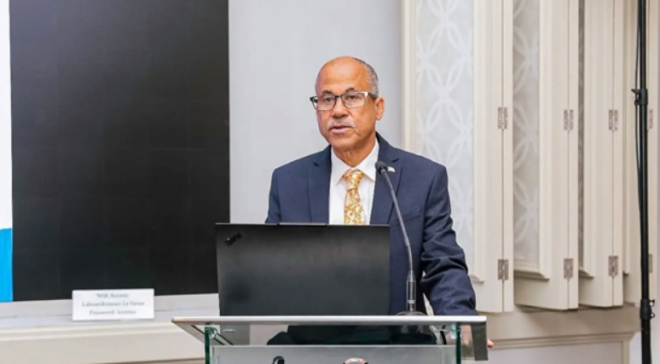
The Chief of Defence Forces, Major General Michael Rosette, told SNA that such incidents represent an evolving maritime security concern alongside more established threats such as piracy and narcotics trafficking.
“We are seeing new crimes. Vessels are being hit with projectiles in the Red Sea and in the Strait of Hormuz,” Rosette said during an interview with SNA on Tuesday.
He said attacks of this nature are particularly concerning because of their potential impact on vessels using international shipping routes and legitimate maritime commerce.
“These are the kinds of crimes that are not good for vessels using the sea,” Rosette said, adding that such actions should not be used to disrupt commerce or other maritime activities.
Beyond the emerging threats, Rosette said Seychelles is also concerned about signs of renewed piracy activity in the region.
“We are seeing piracy return again, and that is one of our major concerns,” he said.
Rosette said Seychelles chairs the Contact Group on Illicit Maritime Activities (CGIMA) and has been closely following recent piracy incidents. The CGIMA is the successor to the Contact Group on Piracy off the Coast of Somalia (CGPCS), which was established as an international coordination mechanism in response to Somali piracy. Its mandate has since broadened to address a wider range of illicit maritime activities while piracy remains an important part of its work.
Under Seychelles' chairmanship, the group has sought to strengthen regional cooperation, information-sharing, capacity-building and coordination among countries and maritime security partners.
The country also hosts the Regional Coordination Operations Centre (RCOC), which works with regional partners to support information-sharing and coordinated responses to maritime security threats in the western Indian Ocean.
“We are very concerned about the recent acts of piracy,” Rosette said.
According to Rosette, around five vessels were still being held off the Somali coast at the time of the interview. He also referred to a vessel that had recently been released following the payment of a large ransom.
Rosette said Seychelles viewed the renewed piracy activity with concern and urged those involved to abandon such acts and pursue lawful livelihoods.
Piracy is not the only established maritime crime being monitored by Seychelles.
Rosette said authorities are also following narcotics trafficking across the Indian Ocean as well as other illicit activities occurring farther north.
“We are also monitoring narcotics trafficking taking place in the Indian Ocean and other illicit activities happening in the north. We are very aware of what is happening, and we are preparing ourselves for any eventuality should it come closer to us,” he said.
Maritime security is particularly important for Seychelles, an archipelago of 115 islands in the western Indian Ocean whose maritime territory is considerably larger than its land area. The country's economy and population depend heavily on the ocean for trade, fisheries, tourism and connectivity.
For Seychelles, the changing nature of maritime security means authorities are having to monitor both longstanding transnational crimes, including piracy and narcotics trafficking, and newer threats emerging along international shipping routes.
Rosette said Seychelles will continue to follow regional developments closely and prepare for the possibility that these threats could move closer to the country's waters.
Seychelles' experience with Somali piracy
Seychelles has played a prominent role in regional anti-piracy efforts over the years.
Somali piracy became a major security and economic threat to Seychelles from around 2009, as pirate operations spread farther into the western Indian Ocean and towards Seychelles' waters. Seychellois fishermen were among those taken hostage, while the country worked closely with EU NAVFOR's Operation Atalanta, NATO, the Combined Maritime Forces and other international partners on surveillance, interception and prosecution.
At the height of the crisis, Seychelles estimated that piracy cost the country around 4% of GDP, with port and fisheries receipts falling by 30%, while it spent more than €2.3 million annually on anti-piracy patrols and surveillance. Pirate attacks off Somalia peaked at 236 in 2011 before falling sharply to 75 in 2012, 15 in 2013 and two reportedly unsuccessful attacks in 2014.
Seychelles also became one of the region's leading centres for prosecuting suspected Somali pirates. Between 2009 and 2013, the island nation prosecuted more suspected pirates than any other country in the region, and by 2015 its courts had dealt with around 142 suspected pirates, with 138 convictions reported.