China’s Fishing Fleets Face Scrutiny Over Somalia’s Rich but Vulnerable Waters
-
 Staff Reporter GAROWE ONLINE
- Posted On 28-08-2026, 07:36PM
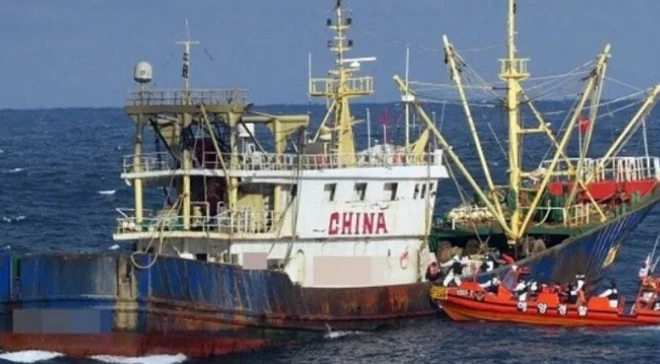
MOGADISHU, Somalia — Somalia’s vast coastline is drawing growing attention from foreign fishing fleets, with Chinese vessels at the center of allegations that valuable fish stocks are being exploited faster than the country can monitor, regulate and benefit from them.
The issue goes beyond illegal fishing. It raises broader questions about who controls Somalia’s marine resources, how fishing licences are issued and whether weak maritime enforcement is allowing foreign operators to take advantage of one of the country’s most valuable natural assets.
A 2025 analysis by the Institute for Security Studies (ISS) said illegal, unreported and unregulated fishing, or IUU fishing, costs Somalia an estimated $300 million a year. It identified Chinese vessels among fleets accused of targeting yellowfin tuna and using fishing methods that can threaten fish stocks and marine ecosystems.
A lucrative resource under pressure
Somalia’s waters are rich in commercially valuable species, particularly tuna. Yellowfin tuna is highly sought after on international markets, making Somali waters attractive to distant-water fishing fleets.
But the country has limited capacity to patrol and monitor its enormous maritime territory. Years of conflict weakened state institutions and maritime surveillance, leaving large areas of the sea difficult to police.
Global Fishing Watch has previously warned that Somalia’s waters are particularly vulnerable to illegal fishing because of limited monitoring, surveillance and enforcement capacity. Its satellite-based analysis has demonstrated how technology can expose fishing activity that authorities cannot easily detect from shore.
The problem is not exclusively Chinese. Earlier satellite analysis identified nearly 200 Iranian and Pakistani vessels operating illegally in Somali and Yemeni waters, demonstrating the wider scale of foreign fishing pressure in the northwest Indian Ocean.
But Chinese fleets have increasingly become a focus of scrutiny.
The Liao Dong Yu case
One of the most prominent examples is the Liao Dong Yu fleet, linked to China’s Liaoning Daping Fishery Group.
ISS researchers said the fleet has a documented history of operating in Somali waters and that some of its vessels obtained fishing licences from Puntland authorities under questionable circumstances. They also alleged that Chinese vessels have used large purse seines, longlines and other methods capable of catching large quantities of tuna. (ISS Africa)
The issue gained further international attention after Liao Dong Yu 578 was hijacked by Somali pirates in January 2026. According to the Global Initiative Against Transnational Organized Crime, counter-piracy officials estimated that between $1.2 million and $1.5 million was paid for the vessel’s release in March. The group said the fleet had a documented history of illegal fishing in Somali waters. (Global Initiative)
The case illustrates the complicated relationship between illegal fishing and piracy along Somalia’s coast. Researchers have long warned that the loss of fishing grounds and competition from industrial foreign vessels can deepen economic pressure on coastal communities and has historically been cited as one factor contributing to piracy.
Licences do not end the controversy
Not every Chinese vessel operating in Somali waters is necessarily illegal.
Somalia’s Ministry of Fisheries and Blue Economy maintains an official database of fishing licences, demonstrating that foreign fishing operations can be legally authorised by the Somali government. The ministry's published records include numerous vessels with Chinese-sounding names among licence holders in previous years. (mfbe.gov.so)
That distinction is critical.
A vessel may possess a Somali licence but still face questions over where it fishes, how much it catches, what equipment it uses and whether it complies with conservation rules.
The central problem is therefore not simply whether a licence exists. It is whether Somalia has enough independent monitoring to verify that licensed vessels are doing exactly what their permits allow.
A system vulnerable to exploitatio
ISS researchers have described Somalia’s fisheries governance as vulnerable to political influence and a lack of transparency. They pointed to the 2018 agreement that allowed Chinese companies to fish within 24 nautical miles of Somalia's coast for $1 million, while noting concerns over the agreement’s transparency and conditions.
Such arrangements have created a difficult question for Somalia: is the country receiving a fair return for the fish being removed from its waters?
For many small-scale Somali fishermen, the imbalance is stark.
A local fisherman operating a small boat cannot compete with an industrial vessel capable of remaining at sea for weeks, using sophisticated equipment to locate and harvest large quantities of fish.
If industrial fishing is poorly controlled, the consequences can extend beyond lost income. Reduced fish stocks can affect food security, employment and the economic survival of coastal communities.
The missing piece: transparency
Modern satellite technology makes it increasingly possible to determine where fishing vessels operate.
Global Fishing Watch uses AIS signals, satellite imagery and machine-learning systems to identify apparent fishing activity. Its researchers have previously found that 94% of industrial fishing effort detected in Somalia was occurring within areas strictly reserved for small-scale fishing.
Such technology could give Somalia a powerful tool to monitor foreign fleets — if the government has the resources and political will to act on the information.
The challenge is turning data into enforcement.
Authorities need accurate records showing which vessels are licensed, who owns them, where they operate, what species they catch and how much they land. Independent observers and electronic monitoring could also help reduce disputes over catches and violations.
Who owns Somalia’s fish?
The fundamental issue is not China alone.
Somalia’s fishing resources belong to a country whose coastal communities have suffered decades of instability while foreign fleets have had access to waters that the state has struggled to protect.
China is one of the world's largest fishing nations, and its distant-water fleet operates across oceans far beyond its coastline. But the responsibility for protecting Somali waters ultimately also rests with Somalia and the international institutions responsible for regulating tuna fisheries.
If foreign fleets are operating legally, Somalia should be able to demonstrate the terms of those agreements publicly.
If vessels are fishing illegally, they should face penalties.
And if licences are allowing excessive exploitation, Somalia should have the authority and capacity to revise them.
The stakes are high. A fishery worth hundreds of millions of dollars could become a long-term economic asset for Somalia — or a resource depleted before Somali fishermen and coastal communities have a chance to benefit from it.
The question facing Mogadishu is therefore increasingly urgent: can Somalia turn its vast coastline from a poorly guarded frontier into a properly regulated national economic resource?
GAROWE ONLINE