Editorial | The Recall of the U.S. Ambassador to Somalia Must Trigger Stronger U.S. Political Engagement
-
 GAROWE ONLINE
- Posted On 23-12-2025, 09:19PM
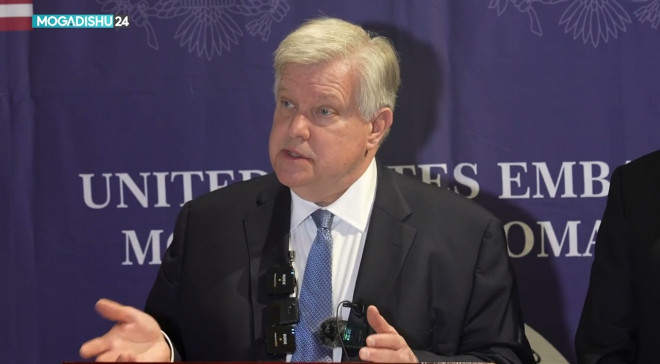
EDITORIAL | According to available reports, the U.S. Ambassador to Somalia is among the diplomats recently recalled by the United State Department. This development comes at a sensitive moment that has repeatedly defined Somalia’s political calendar—at a time when the mandate of the Federal Government is nearing its end, while no nationally agreed framework exists on elections or the political direction the country is heading.
This coincidence should not be viewed lightly. Somalia has reached a stage where political disputes at the end of every federal term have become routine. Each year, Somali leaders return to the same unresolved debates—over electoral models, timelines, and constitutional interpretation—while the country remains trapped in a prolonged state of political transition.
More than thirty years after the collapse of state institutions, no fundamental transformation has taken place. Somalia has yet to fully recover from the breakdown of governance, a failure that has become a national tragedy. This unfortunate reality persists despite sustained international efforts over many years.
For a long period, the United States has invested significant resources—financial, military, and diplomatic—to help Somalia regain stability. American taxpayers have funded security operations, institutional development, and humanitarian assistance. Nevertheless, the outcomes achieved so far remain limited.
Without U.S. military and intelligence support, the fight against Al-Shabaab would not have continued. The reality is clear: had the United States withdrawn its support, the group would likely have taken control of much of southern Somalia and the capital long ago. While security gains have prevented that outcome, they merely hold the situation in place; they do not resolve the broader challenges the country continues to face.
Somalia’s most serious crisis is political.
Over the past thirty years, Somalia has failed to produce political leadership capable of moving the country beyond perpetual transition. Many politicians remain focused on power, office, and narrow self-interest, rather than on building institutions, honoring national agreements, or preparing the country for genuine recovery. As a result, international assistance has become temporary and reactive, without altering the country’s overall trajectory.
At the same time, statements emerging from Washington that undermine the dignity of the Somali people serve no constructive purpose—especially when the U.S. government continues to spend millions and billions of dollars to prevent Somalia’s collapse. Such rhetoric only weakens public confidence in the long-term intentions of U.S. policy toward Somalia.
For this reason, the recall of the U.S. Ambassador should not be viewed merely as a routine diplomatic change. It should be treated as an opportunity to reassess Washington’s role in Somalia.
The time has come for the U.S. government—particularly the State Department—to take a more direct and firm role in shaping Somalia’s political direction. Somalia does not need disengagement. It needs clear, strong political engagement backed by accountability.
Washington should appoint an ambassador with real political authority—one capable of confronting damaging political disputes, pushing Somali leaders toward consensus, and preventing endless cycles of meaningless political maneuvering. Diplomacy must be active and consequential, not passive observation.
Equally important is accountability for the large volumes of financial assistance flowing into Somalia. The United States has both the right and the responsibility to reject outcomes that produce no results. Too often, leaders in Villa Somalia have entered economic arrangements and resource agreements with countries that contribute little or nothing to Somalia’s stabilization during this critical period, while marginalizing partners who bear the real cost of sustaining the country. This situation cannot continue.
Somalia’s problem is not a lack of international support. It is the absence of accountable leadership.
If the United States continues to fund Somalia without holding political authorities accountable, meaningful change will remain elusive. The recall of the ambassador must represent a real turning point. Somalia needs firm diplomacy, clear conditions, and leadership that serves the Somali people—not narrow interests sustained by unaccountable international backing.
Editorial Note
This editorial reflects the views of Garowe Online and is intended to draw the attention of the United States government—particularly the U.S. State Department—to the political uncertainty facing Somalia. It is grounded in the need for accountable leadership during the country’s long and ongoing recovery process.
GAROWE ONLINE