NUSOJ Sounds Alarm Over Repressive Draft Penal Code Threatening Media Freedom and Fundamental Rights
-
 NUSOJ Press Release
- Posted On 26-06-2026, 11:03AM
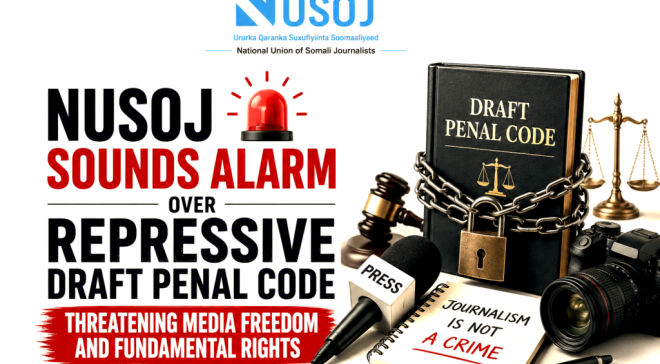
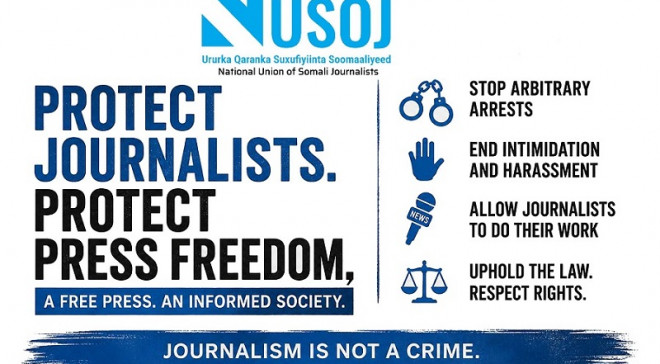
The National Union of Somali Journalists (NUSOJ) has today expressed grave concern over the draft Somali Penal Code approved by the Council of Ministers on 4 December 2025 and transmitted to the House of the People, warning that unless the Bill undergoes substantial revision, it poses an imminent threat to freedom of expression, independent journalism and a broad range of fundamental human rights guaranteed under the Provisional Constitution of Somalia and international human rights law.
While welcoming the federal government’s decision to reform Somalia’s Penal Code as an important and long-overdue step, particularly after previous administrations failed to undertake such a process, NUSOJ considers the approval of the draft by the Council of Ministers to offer an opportunity to modernise and progressively reform Somalia’s criminal justice framework. This process should ensure that outdated provisions inherited from the past are replaced with legislation fully aligned with the constitution and Somalia’s international human rights obligations, while strengthening democracy, the rule of law, accountability and the protection of fundamental rights.
However, NUSOJ is deeply concerned that this historic oppoHowever, NUSOJ is deeply concerned that this historic opportunity is at serious risk of being lost unless the draft penal code is substantially revised.rtunity is at serious risk of being lost unless the draft penal code is substantially revised. Rather than making a decisive break from the restrictive legacy of the 1964 Penal Code, the Bill reproduces many of its repressive provisions while introducing additional offences that significantly expand the scope for criminalising journalism and the exercise of freedom of expression, including legitimate public criticism while at the same time curtailing other fundamental rights and freedoms. If enacted without substantial amendments, the Bill risks entrenching legal provisions that are incompatible with the Provisional Constitution and Somalia’s international human rights obligations.
Following a comprehensive legal analysis of the Draft Somali Penal Code, NUSOJ has identified numerous articles and provisions that raise serious concerns regarding their compatibility with the Provisional Constitution of Somalia and the country’s international human rights obligations both at the continental level and globally. The legal review found that several provisions directly threaten freedom of expression and media freedom by criminalising legitimate journalistic activities and public discourse. In particular, Articles 144, 157, 158, 163, 170, 221, 224, 235, 307, 308, 418, 420 and 423 contain restrictive offences relating to criminal defamation of the President; vague offences concerning false or misleading information; economic reporting; acts alleged to harm Somalia’s foreign interests; insult to the nation or state institutions; defamation of public officials; defamation of public institutions; general criminal defamation; criminal insult; morality and public order; recording images without consent; and electronic defamation. Collectively, these provisions present a grave and immediate threat to independent journalism, investigative reporting and the exercise of the constitutional right to freedom of expression.
NUSOJ’s legal analysis further uncovers that these provisions in Bill contain vague and overly broad concepts such as “false information”, “national interests”, “public order”, “economic confidence”, “morality” and “insult”, without providing precise legal definitions or adequate safeguards against arbitrary enforcement. Such provisions fail to satisfy the principles of legality, necessity and proportionality required under international human rights law. Their broad wording significantly risks criminal investigations, trumped-up charges, or prosecution for journalists and citizens reporting on public interest issues like corruption, elections, security operations and governance failures.
NUSOJ is particularly alarmed by the retention and expansion of criminal defamation and insult offences. While many African countries repealed or decriminalised criminal defamation, the Draft Penal Code seeks to entrench and expand these repressive offences. The Bill continues to impose criminal penalties, including imprisonment, for speech-related offences and grants special protection to public officials and State institutions against criticism. Such provisions are inconsistent with African and international human rights standards, which require public officials to tolerate greater public scrutiny and discourage the use of criminal law to protect reputation. The African Court on Human and Peoples’ Rights, the African Commission on Human and Peoples’ Rights and the United Nations Human Rights Committee have consistently recognised that criminal defamation laws have a chilling effect on freedom of expression, undermine independent journalism and inhibit open public debate in democratic societies.
Beyond freedom of expression and media freedom, NUSOJ’s legal review has identified several additional provisions that raise serious concerns regarding the protection of fundamental human rights. A number of these provisions require thorough amendment to ensure full compliance with Somalia’s obligations under the International Covenant on Civil and Political Rights, the African Charter on Human and Peoples’ Rights and other international and regional human rights instruments. Particular attention should be given to strengthening the protection of the rights of women and children, due process guarantees and other constitutional rights and freedoms.
If this legislation is enacted in its current form, it will mark a serious regression for constitutional rights and democratic governance in Somalia. It will expand the criminalisation of journalism, discourage investigative reporting, restrict public debate and weaken the role of the independent media in promoting transparency, accountability and good governance. Legislation that criminalises freedom of expression would undermine Somalia’s efforts to transition to democracy and public confidence in the rule of law.
NUSOJ Secretary General Omar Faruk Osman said: “This is a defining moment for Somalia’s legal reform process. Reform must replace outdated, draconian laws with legislation that aligns with the Constitution and Somalia’s African and international human rights obligations, not extend restrictions that undermine fundamental rights and freedoms. In its current form, this Bill presents an immediate and serious threat to freedom of expression, media freedom and the public’s right to know. If enacted without substantial amendments, it will expose journalists, news media organisations and ordinary citizens to criminal prosecution for exercising rights that should be protected in a democratic society. We call for a comprehensive, transparent and participatory review of the entire Bill to ensure that every provision complies with constitutional guarantees and international human rights standards. Somalia deserves a modern Penal Code that strengthens justice, protects human rights and safeguards, rather than criminalises, independent journalism and free expression.”
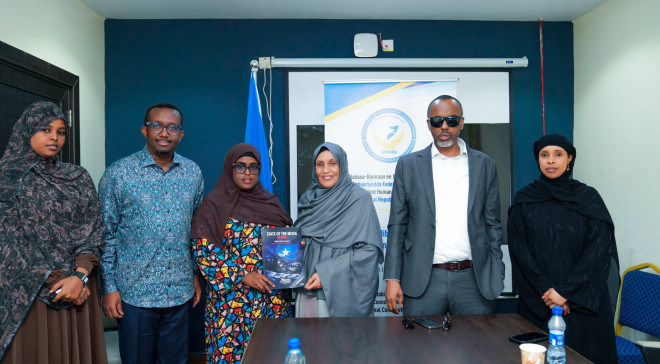
NUSOJ calls upon the Ministry of Justice and Constitutional Affairs and the House of the People of the Federal Parliament of Somalia to undertake a comprehensive, transparent and inclusive review of the Draft Penal Code before its final consideration and adoption. NUSOJ will continue its engagements with the government and members of parliament throughout the legislative process by providing legal analysis and recommendations to ensure that the final law upholds constitutional guarantees, strengthens the rule of law and fully complies with Somalia’s international human rights obligations.