Opinion – Sovereignty Snafu: Somalia, Israel, and Somaliland’s Diplomatic Dance
-
 Abdirahman Jeylani Mohamed
- Posted On 07-01-2026, 12:35PM
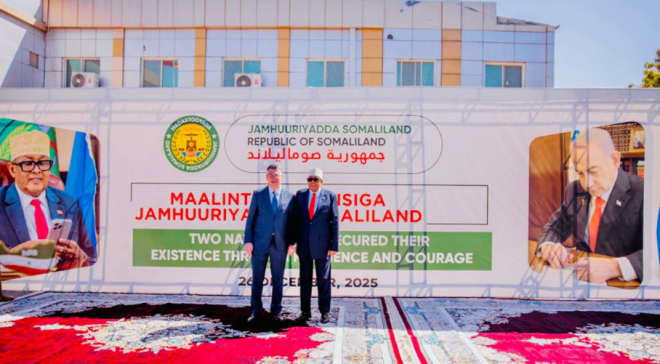
When the State of Israel announced its formal recognition of Somaliland in late December 2025, the reverberations reached far beyond the Horn of Africa. In Mogadishu, the reaction among senior diplomats was not merely one of protest — it was a profound sense that an enduring principle of international relations had been challenged.
Across multiple conversations in the Somali Ministry of Foreign Affairs, envoys described the recognition as a diplomatic rupture — a decision with implications not only for Somalia’s territorial integrity, but for the very architecture of state sovereignty in Africa and beyond.
Sovereignty Under Diplomatic Strain
Somalia responded swiftly and unequivocally. Official communiqués denounced the recognition as a violation of international law and established norms of territorial integrity, asserting that Somaliland remains an integral part of the Federal Republic of Somalia. Somali officials argue that no external actor possesses the mandate to redefine borders without the consent of the sovereign state concerned.
In my interviews with diplomats, one senior official articulated this concern bluntly: “This is not a mere political disagreement — it is an affront to the foundational rules that govern inter‑state relations. If borders can be recalibrated by unilateral recognitions, the entire edifice of post‑colonial stability in Africa is imperiled.”
Another envoy, seasoned in multilateral negotiation, said privately, “Our task now is to ensure that this aberration does not metastasize into precedent.” Their worry: that small, incremental deviations from established norms could cumulatively erode the safeguards that have kept conflict at bay across a continent marked by historical fragmentation.
Multilateral Advocacy, Not Rancor
Even as Somali diplomats expressed indignation, their language was measured and strategic rather than emotive. At the United Nations, Somalia’s ambassador articulated a position rooted in legal fidelity and constructive engagement. The message was clear: reject any attempt to dilute the principle of sovereign consent, even as dialogue channels remain open.
In private meetings with African Union representatives, Somalia’s envoys emphasized adherence to “uti-possidetis juris” — the doctrine affirming colonial boundaries as the basis for sovereign borders. This principle underpins continental stability and has been invoked by the AU in demanding the revocation of Israel’s recognition of Somaliland.
A diplomat close to these deliberations observed, “Our resistance is not born of animosity toward any state; it is a defense of a system that protects all states, large and small.”
Legitimacy and Diplomacy in a Contested Landscape
During my engagement with senior officials at Somaliland’s Ministry of Foreign Affairs, they characterized Israel’s recognition as a definitive milestone in legitimizing Somaliland’s sovereign aspirations on the international stage.
While acknowledging Somalia’s objections, they asserted that Hargeisa’s pursuit of recognition is anchored in principles of self-determination, legal precedent, and strategic statecraft, rather than provocation or unilateral escalation.
One senior diplomat emphasized that Somaliland’s foremost priorities remain institutional consolidation, robust international partnerships, and sustainable security architecture, signaling a disciplined approach to expanding its global engagement while navigating the delicate geopolitical landscape of the Horn of Africa.
Inside Mogadishu’s Diplomatic Halls
In conversations with senior foreign diplomats based in Mogadishu, several emphasized that Israel’s recognition of Somaliland represents a delicate challenge to regional stability, underscoring the imperative of upholding international norms without escalating tensions.
They noted that while the decision could be interpreted as a sovereign choice by Israel, it simultaneously risks setting a precedent that undermines the principles of territorial integrity and multilateral consensus across Africa.
At the same time, these envoys stressed the importance of measured engagement, advocating for dialogue, legal frameworks, and diplomatic channels as the most effective tools to address the dispute while preserving Somalia’s sovereignty and broader regional cohesion.
Strategic Anxiety in the Red Sea Theater
Beyond legal objections, Somali officials articulate geostrategic apprehension. Israel’s move is widely interpreted in Mogadishu as part of a broader repositioning around the Red Sea — a maritime corridor of critical global significance. Recognition, in this context, is not purely symbolic; it could be a prelude to deeper security and economic engagements that reshape regional alignments.
One senior foreign ministry adviser told me, “Recognition can lead to deployments, agreements, and partnerships. We cannot view these developments in isolation from the larger tectonics of regional security.”
While Somaliland’s leadership has denied any plans for foreign bases, Somali diplomats remain cautious, noting that perceptions — not just facts — influence strategic stability. In their view, external footprints in contested spaces risk exacerbating existing tensions and inviting non‑state violent actors to exploit political fault lines.
Narrative Warfare: Somalia’s Diplomatic Offensive
Somalia’s response has not been limited to condemnation. Behind the scenes, diplomats are mounting a comprehensive narrative campaign aimed at reinforcing global adherence to legal norms. In New York, Mogadishu’s mission has framed the issue as a matter of collective concern, urging member states to reaffirm that sovereignty cannot be conditional upon the preferences of powerful capitals.
Regionally, Somalia is cultivating alliances through quiet diplomacy — engaging with the African Union, Arab League, and key capitals in Africa and the Middle East to build consensus against unilateral recognitions that sidestep sovereign consent. A senior diplomat explained, “We are marshaling legal arguments and shared interests. This is a fight for the integrity of international order, not a parochial grievance.”
Domestically, the tone is similarly calibrated. Government communications emphasize resilience and unity, channeling public frustration into constructive narratives about national cohesion and strategic agency.
The Personal Stakes Behind Diplomatic Language
In conversations off the record, a recurring theme emerged: the recognition struck a personal chord for many envoys — not as a theoretical dispute, but as an affront to the lived experiences of a nation shaped by decades of struggle against fragmentation.
One diplomat, reflecting on his early career during Somalia’s civil war, said quietly, “Borders were not just lines drawn on a page for us — they were lifelines for families, identities, futures. What is at stake now is not abstract; it is deeply human.”
Another remarked, “Our credo is peaceful diplomacy and legal order. But every diplomat here carries the weight of our history and the urgency of safeguarding a future where peace is not negotiable.”
A Neutral, Unyielding Logic
Despite the emotional weight behind these positions, Somalia’s diplomatic posture is far from antagonistic. It is principled, calibrated, and rooted in legal logic. Somalia has not severed dialogue with Israel; instead, it urges a reconsideration of decisions that, in its view, undermine collective norms. This formulation reflects a nuanced balance: asserting national interests while maintaining channels for cooperation on areas of mutual concern.
This balanced rhetoric is strategic. By framing its objections within universally accepted legal frameworks, Somalia seeks to avoid polarizing alignments and instead build broad coalitions across geopolitical divides.
Conclusion: The Wider Implications
Israel’s recognition of Somaliland has catalyzed a profound diplomatic moment for Somalia — one that tests the durability of international law, the resilience of sovereign states, and the capacity for reasoned engagement amid geopolitical competition.
Somalia’s diplomats, in their formal statements and candid conversations, present a unified strategic vision: uphold sovereign consent, strengthen multilateral norms, and engage the world not with rancor but with resolute logic. In an era of shifting alliances and emerging powers, their message is clear: the principles that govern nations must not be contingent upon the preferences of the powerful.
In the months ahead, how this dispute unfolds will offer insight not only into Somalia’s diplomatic acumen, but into the enduring strength — or fragility — of the international order that binds states together.
The author is Abdirahman Jeylani Mohamed, a Somali journalist based in Mogadishu, foreign policy commentator and communications specialist.