As Justin Davis Leaves Mogadishu, Washington Is Asking a Different Question About Somalia
-
 Omar Faruk NUSOJ Secretary General
- Posted On 08-09-2026, 07:31AM
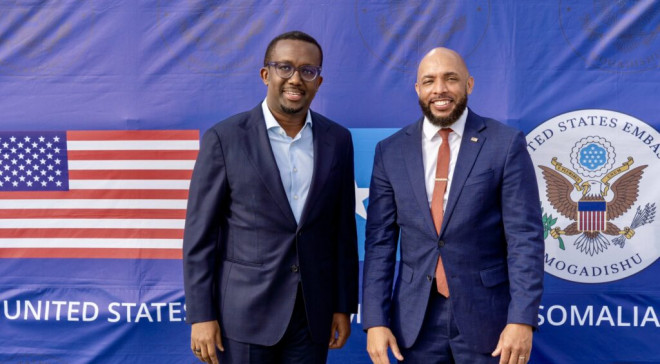
As Justin Davis concludes his tenure as Chargé d’Affaires at the United States Embassy in Mogadishu, he leaves at a time when the relationship between Somalia and the U.S.is changing, perhaps more significantly than official statements suggest.
Over recent months, I have spoken with several American diplomats in Mogadishu, Nairobi, New York, Washington and elsewhere about where the U.S. now stands on Somalia. Some are serving officials, while others know the Somalia file closely. They did not agree on everything and some were more candid than others, but the conversations repeatedly came back to the same question: how much responsibility are Somalis themselves prepared to take for the future of their country?
Davis has run the US Embassy through a particularly difficult period. Politics in Washington changed sharply as “America First” came to define the administration’s approach abroad. In Somalia, political divisions deepened, relations between the Federal Government and some Federal Member States deteriorated and Al-Shabaab and Daesh continued to pose serious security threats. At the same time, competition among foreign powers for influence in Somalia and the wider Horn of Africa intensified.
One American diplomat described Davis’s challenge to me as finding a way to reconcile “America First” with “Somalia First”.
When I asked what “Somalia First” meant, the answer was strikingly straightforward: Somalia for Somalis, strong Somali institutions and political leaders taking responsibility for their own country. Several diplomats worried that foreign interests had become too entangled with Somalia’s domestic political competition and that Somali politicians were themselves sometimes opening the door to that interference.
“Somalia’s future is not for sale,” one diplomat told me.
It was not an argument for Somalia to turn away from international partners. The country needs them and none of the Americans I spoke with disputed that. Their concern was that Somalia cannot insist on its sovereignty while allowing domestic political disputes to become entangled with competing foreign agendas. In their view, Somali politicians have to find ways of settling their differences without constantly looking towards foreign capitals.
Another diplomat was equally direct. “Somalia is not a child. Somalia is a partner,” he said. America was prepared to cooperate with Somalia and support it, but the relationship had to be one between partners, with Somalia taking responsibility for its own choices and future.
Under the current US policy, American interests in Somalia have become narrower and more clearly defined. Three priorities came up repeatedly in my conversations: counterterrorism, law enforcement cooperation and immigration coordination. These are increasingly the hard interests around which Washington is organising its relationship with Mogadishu.
But the American assessment of Somalia was far from entirely negative. Diplomats acknowledged good progress in law enforcement cooperation and immigration coordination and spoke positively about the working relationship with Somali authorities in these areas. They also recognised that Mogadishu is considerably more peaceful than it was before, something several of them regarded as an important achievement that should not be overlooked.
Their frustration was much greater when the conversation moved beyond Mogadishu. American diplomats were unhappy with the pace of counter-offensive operations against Al-Shabaab outside the capital. They had expected greater movement and more sustained gains on the ground. Their concern was not simply about launching military operations but whether those operations were producing lasting results and maintaining sufficient pressure on Al-Shabaab.
Politics inevitably entered that discussion. Several diplomats believed the prolonged confrontation between the federal government, federal member states and opposition politicians was taking attention away from the security campaign. To them, political cohesion and the fight against Al-Shabaab are not separate issues. A country whose political leaders are consumed by disputes among themselves will inevitably find it more difficult to sustain a coherent national security effort.
The reduction in American humanitarian and development assistance also reflects the wider change in Washington. One diplomat pushed back when I described this as a retreat from humanitarian engagement. He preferred to call it a “reorganisation of assistance”, with more emphasis on priorities, accountability and results. Others were more candid in acknowledging that America’s broader interest in Somalia had declined and that Washington was reconsidering how much money and political attention it was prepared to commit.
Some also admitted that Washington itself had spent several years struggling to decide exactly what its overriding national security interests in Somalia were. Over time, American engagement had expanded into counterterrorism, security assistance, humanitarian relief, state-building, democratisation and political mediation. The current approach is much less expansive.
The message now is simpler: America will help Somalia, but Somalia must also help itself.
That view becomes particularly clear when American diplomats talk about Somali politics. They see fragmentation on almost every side. Within the federal government, the executive, parliament and other state institutions appear increasingly aligned. Yet relations between Mogadishu and important Federal Member States remain badly fractured, particularly with Puntland and Jubaland.
The Americans are not putting all the blame on Villa Somalia. They are also critical of the opposition. Several diplomats, in separate conversations, used exactly the same word to describe it: “fragmented”. They questioned how much opposition leaders trust one another and whether their alliances are built around a common political programme or simply the convenience of opposing the current leadership.
One diplomat posed a difficult question: if opposition to one administration is what brings everyone together, what happens when that administration is no longer there?
What struck me during these conversations was that the Americans were rarely questioning the competence of Somalis themselves. They spoke about capable politicians, professionals, entrepreneurs, civil society leaders and a remarkably resilient population. Their frustration was that all this talent had still not produced enough political cohesion around a minimum national interest.
One senior diplomat used the U.S. itself as an example. He spoke about “American exceptionalism”, not to suggest that American politicians agree with one another, but almost to make the opposite point. American politics can be bitterly divided, he said, yet there remains a sense of national identity and certain interests around which Americans can still rally.
His question was: what is the Somali equivalent?
Curiously, the Americans saw a glimpse of an answer in the controversy involving Somalia’s renowned referee Omar Artan.
A senior diplomat told me that when Artan was returned from the U.S. and was not allowed into the country, calls to the US Embassy in Mogadishu were incessant. According to the diplomat, President Hassan Sheikh Mohamud was among those seeking an explanation. But what fascinated American officials even more was the public reaction that followed.
Diplomats in Washington, Mogadishu, Nairobi and elsewhere were closely watching the scenes of large numbers of young Somalis gathering at Mogadishu Stadium. They saw Somalis who would normally find themselves on different sides of political divides rallying around the same issue. It prompted a question among some of those watching: if Somalis could rally together so powerfully around Omar Artan, why could that same sense of national solidarity not be mobilised around Somalia?
For some of the diplomats, the episode demonstrated that the national feeling exists. The problem is turning it into a political culture that can survive elections, clan calculations, disputes between governments and the influence of foreign powers.
There is an obvious contradiction in some of this American thinking and the diplomats themselves are not unaware of it. For years, the U.S. was one of the most influential external actors in Somali politics. When a serious political crisis erupted, Somali leaders and international partners looked towards Washington. The Americans convened, persuaded, applied pressure and helped push political rivals towards compromise.
That America is less visible today.
Some Somali politicians and international partners regard this as a weakness in the current American approach. They believe Washington has withdrawn too far from political engagement and that its reduced role has left a vacuum at precisely the wrong time. Their argument is that America still carries political weight that few other countries can match and that Somalia sometimes needs that weight when its leaders cannot reach compromise.
American diplomats increasingly turn the argument around: why should the U.S. always be responsible for bringing Somali politicians together?
The question comes at a particularly sensitive moment because while America is becoming more selective, other powers are becoming more active.
China’s presence has become increasingly visible. Beijing has expanded its engagement through repeated diplomatic contacts, visits and programmes involving several sectors. China also speaks consistently and forcefully about Somalia’s sovereignty, unity and territorial integrity. Its growing engagement is difficult to ignore at a time when Washington is narrowing the range of issues on which it wants to lead.
Türkiye is an even more established presence. Its relationship with Somalia stretches across military training, security, trade, infrastructure, energy and diplomacy. Ankara has invested in Somalia for the long term and has built relationships that go much deeper than conventional development assistance. Its political and economic importance continues to grow.
The United Arab Emirates (UAE) presents a different and more difficult picture. Its relationship with the Federal Government has become strained while it maintains much closer ties with Puntland and Jubaland as well as substantial interests and longstanding relationships in Somaliland and with certain Mogadishu-based politicians. There is also a strong perception among many Somali political actors that Abu Dhabi favours Somaliland’s agenda.
Somalia therefore finds itself in an increasingly crowded geopolitical arena. Foreign powers have interests in the country and those interests do not always coincide. There is nothing unusual about foreign countries pursuing their own interests. The real question is whether Somalia has a strong enough sense of its own national interest to manage those relationships rather than allowing competing foreign interests to become entangled in its internal political struggles.
That may be the wider story of the period in which Justin Davis ran the US Embassy. His tenure may not be remembered for one dramatic agreement or diplomatic breakthrough. Instead, he has managed the relationship during a period when Washington itself was deciding what America still wants from Somalia and what it expects Somalis to do for themselves.
America has not abandoned Somalia. It remains an important security partner and counterterrorism cooperation continues. Diplomats point to progress in law enforcement and immigration cooperation and acknowledge the greater peace and security Mogadishu enjoys today. But they are also frustrated by the slow pace of counter-offensive operations outside the capital and deeply concerned that Somalia’s political divisions are making the security challenge harder.
As Davis leaves Mogadishu, one thing should also be said about his own record. He took charge of the US mission at a difficult time and managed to keep America engaged and its relationship with Somalia on course despite political tensions in both countries and a changing agenda in Washington. He kept the door open to different Somali political actors and continued to press for Somalis to find common ground. In that sense, Davis leaves having done something important: keeping a difficult relationship together while reminding Somalia’s leaders that, in the end, the country belongs to them and its future has to be decided by them.
After all the conversations I have had with American diplomats, their message can perhaps be reduced to this: America is prepared to work with Somalia, but Somalis have to decide what they want Somalia to be.
There is also a challenge for Washington in that position. If America reduces its political role faster than Somali institutions can fill the space, that space will not simply remain empty. Foreign powers have their own strategic and economic interests and they will continue to pursue them.
As Justin Davis leaves Mogadishu, the bigger question is therefore not simply what America will do next. It is whether Somalia’s leaders can find a minimum national understanding that survives changes of government, disputes between Mogadishu and the Federal Member States, opposition politics and competing relationships with foreign powers.
The Americans I spoke with seemed convinced that Somalis are capable of doing that. They are simply becoming less convinced that America should do it for them.
By Omar Faruk Osman, Secretary General of National Union of Somali Journalists (NUSOJ).