OP-ED | Southwest Somalia: A Political Crisis Becoming a Civil War
-
 Abdirashid Hashi
- Posted On 06-09-2026, 06:27AM
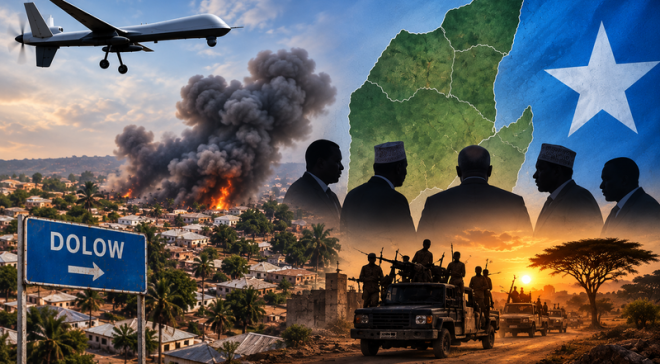
OP-ED | Four things need to be said about the Dolow drone attack and what is happening in Southwest.
First, political competition is drifting towards a man-made civil war. Second, successive federal leaders, by manipulating Southwest for short-term ends, have weakened the state and the federation itself. Third, Dolow marks a dangerous threshold: military firepower, possibly borrowed from an external partner, brought into an internal political contest. And fourth, responsible people in Southwest must see what is happening — their communities are being divided, armed and turned into pawns in other people’s battles.
Southwest was vulnerable before this crisis. Al-Shabaab controls or contests much of its countryside and, without independent revenues, the state depends heavily on Mogadishu. Successive federal presidents exploited that vulnerability rather than build institutions to hold the state together.
In 2018, President Farmaajo’s government pushed Sharif Hassan Sheikh Aden aside, arrested presidential candidate Mukhtar Robow and, with Ethiopian military support, effectively installed Abdiaziz Laftagareen.
Seven years later, history is repeating itself with the alliances reversed. President Hassan Sheikh Mohamud first kept Laftagareen beyond his term, then turned against him. Former speaker Aden Madobe, who helped deliver Mohamud’s term extension and constitutional changes, has emerged as Mogadishu’s preferred man.
Laftagareen is not leaving without a fight; forces associated with his camp have attacked Baidoa and clans are being dragged in. This is where federal political games stop being games: they tear apart a federal state and weaken the federation itself.
Then came Dolow.
A drone struck the residence of Laftagareen ally Gen. Mahad Abdirahman Aden, Gen. Shub, injuring him. Shub, Laftagareen’s father-in-law, had vowed to prevent Madobe from ruling Southwest.
Who operated the drone and, more importantly, who asked for and authorized it must be established.
Somalia, Türkiye and the United States operate armed drones in Somalia. Laftagareen’s supporters and opposition figures accuse Türkiye of being used to eliminate HSM’s political rival; Türkiye has not spoken publicly. The federal government says explosives were being made there. The debris will tell us more.
Even if the government believed Shub was directing an armed insurgency, it could have indicted him and sought his arrest. Sending a drone as it seems into a residence means willing to kill whoever happens to be around the target — family, guards, neighbours or bystanders.
That disregard for other lives is what we what Al-Shabaab does when they indiscriminately bombs a place because someone it wants to kill may be there. Whoever was behind Dolow attack must be identified and held accountable.
And this is where Southwest must think straight, particularly its responsible politicians, elders, academics, businesspeople and civil society.
The Digil and Mirifle, historically among Somalia’s more cohesive clan families, are being torn into armed camps that will leave them weaker whoever wins. No sub-clan can overpower the others and no politician will build a durable Southwest by asking externals to send money, troops or drones against his neighbours.
Bay and Bakool have already paid too much through famine, displacement and Al-Shabaab. Their people need to be held together and their disputes returned to politics before this takes on a life of its own.
Somalia knows where such shortcuts lead. In 1991, power struggle became civil war; outside help was summoned and consequently Somalia was left without a functioning government for more than a decade, and the state remains fragile more than three decades later.
The myopic politicians reaching for shortcuts should remember those who open the door to civil war rarely decide how far it goes — or the price they, and everyone else, will pay for it.
By: Abdirashid Hashi | Analyst, Researcher and Former Minister
Abdirashid Hashi is an analyst and researcher. The views expressed in this article are those of the author.