Rebuilding Somalia’s Central Bank: The Role of Merit-Based Recruitment and Institutional Reform
-
 Staff Reporter GAROWE ONLINE
- Posted On 04-11-2026, 10:34PM
MOGADISHU, Somalia — Rebuilding public institutions after decades of conflict requires more than restoring administrative structures or introducing new regulations. It demands qualified professionals, effective governance systems and sustained institutional reform.
The Central Bank of Somalia offers a notable example of this process. Since 2019, the institution has undertaken reforms aimed at strengthening professional capacity, modernising internal operations and improving financial accountability. These changes have taken place alongside an expansion of its regulatory responsibilities and efforts to restore confidence in Somalia’s financial system.
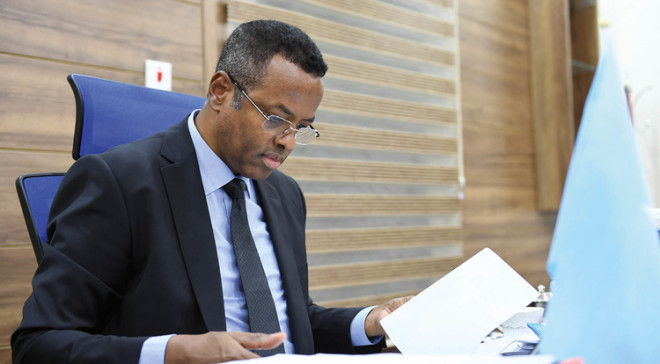
In a November 2026 interview with African Business, Governor Abdirahman Mohamed Abdullahi reflected on the challenges of rebuilding the Bank, particularly the shortage of specialised professionals and the need to establish credible institutional systems.
The experience raises a broader question for Somalia’s public sector: how can institutional reforms produce lasting improvements beyond the tenure of individual leaders?
Rebuilding from a Weak Institutional Foundation
When Abdirahman assumed office in April 2019, the Central Bank faced substantial operational and institutional constraints. Its activities were largely limited to providing fiscal agency services to the government and supervising five commercial banks and several money transfer businesses.
The institution lacked sufficient specialised personnel, relied heavily on manual processes and faced a three-year backlog of unaudited financial statements.
In an October 2026 article published by African Business, titled Central Bank of Somalia: At the Heart of a National Transformation, Abdirahman described the scale of the challenge:
“The transformation has been profound and exceptionally challenging because we began from a very low institutional baseline.”
These weaknesses reflected broader challenges across Somalia’s public administration, where prolonged instability had disrupted professional development and weakened institutional continuity. Addressing them required more than additional resources. It called for an organisational framework capable of supporting professional standards, effective management and long-term institutional development.
Strategic Planning and Merit-Based Recruitment
One of the Bank’s initial priorities was establishing a clear strategic direction. With support from a World Bank-financed expert, the institution developed a four-year strategic plan, conducted a skills-needs assessment and introduced merit-based recruitment procedures. The resulting 2020–2024 Strategic Plan provided a framework for strengthening governance, financial management, regulatory supervision and institutional capacity.
Central to these reforms was the recognition that effective central banking requires specialised expertise in economics, financial regulation, banking supervision, risk management and information technology.
Finding professionals with these qualifications presented a considerable challenge. In his November interview, Abdirahman identified the shortage of experienced central banking professionals as a major obstacle to institutional development.
The Bank responded by strengthening its human resources framework and introducing recruitment procedures intended to prioritise qualifications and professional competence. According to the Governor’s Statement published on the CBS website:
“Recognizing that human capital is our greatest asset, we institutionalized merit-based recruitment, introduced a performance management system, and invested heavily in staff training and capacity building.”
Merit-based recruitment is an important foundation of effective public administration. When consistently implemented, it can strengthen institutional competence, improve organisational performance and promote confidence in public service.
However, recruitment policies alone cannot guarantee institutional effectiveness. Their success depends on transparent selection procedures, professional development, performance assessment and the retention of qualified employees.
Investing in Professional Capacity
The Central Bank’s recruitment reforms have been accompanied by investments in staff training and institutional capacity development.
Technical assistance from the International Monetary Fund, World Bank and other partners has supported improvements in professional expertise, governance and financial-sector regulation. These initiatives have become increasingly important as the Bank has assumed more complex responsibilities, particularly in financial supervision and payment-system oversight.
Professional development also contributes to institutional continuity. By strengthening technical expertise across departments and introducing performance management systems, institutions can reduce dependence on individual employees and develop more consistent operational standards.
For Somalia’s public sector, this distinction is significant. Sustainable institutional capacity requires not only attracting qualified professionals but also creating an environment in which their expertise can develop and be retained.
Strengthening Governance and Financial Accountability
Alongside workforce development, the Central Bank has introduced reforms covering financial management, procurement, human resources, information technology and internal controls.
According to the Governor’s 2025 audit statement, these measures have included implementing recommendations arising from the IMF safeguards assessment and strengthening operational policies and procedures.
One of the clearest indicators of progress has been the improvement in financial reporting. From a three-year backlog of unaudited financial statements in 2019, the Bank has reported six consecutive unqualified external audit opinions covering the financial years 2020 through 2025.
Although an unqualified audit opinion does not provide a comprehensive assessment of institutional performance, it offers assurance regarding the presentation of financial statements. The transition to consecutive clean audit opinions therefore represents measurable progress in financial reporting and accountability.
Expanding Financial Sector Supervision
The Bank’s institutional reforms have coincided with a substantial expansion of its regulatory responsibilities. In 2019, the Central Bank supervised five commercial banks and several money transfer businesses. Today, it licenses and supervises 71 financial institutions, comprising 15 commercial banks, 17 money transfer businesses, six mobile money service providers, 23 microfinance institutions, two payment systems and eight Takaful operators.
This expansion reflects the increasing diversity of Somalia’s financial sector and the growing demands placed on its principal financial regulator. Supervising these institutions requires expertise in financial analysis, compliance, risk management, digital payments and consumer protection.
The revised Financial Institutions Law of 2025 and other regulatory reforms have strengthened the legal framework for financial-sector oversight. The Bank has also moved towards risk-based supervision, supported by efforts to develop professional supervisory capacity.
Nevertheless, the number of licensed institutions is not, by itself, a measure of regulatory effectiveness. Effective supervision also depends on consistent enforcement, reliable information systems and the ability to identify emerging financial risks.
Lessons for Somalia’s Public Institutions
The Central Bank’s experience offers lessons for Somalia’s broader institutional development.
Strategic planning provides direction, while merit-based recruitment helps establish the professional expertise necessary to implement institutional mandates. Training and performance management can strengthen these foundations, provided they are supported by transparent procedures and consistent organisational standards.
Equally important are effective internal controls, credible financial reporting and governance systems that promote accountability.
International technical assistance can accelerate institutional development, but its lasting value depends on whether domestic institutions acquire the expertise and organisational capacity to sustain reforms independently.
Perhaps the most important consideration is continuity. Institutional reforms must become established practices rather than initiatives dependent on individual leaders.
Building Institutions That Endure
Eight years after the beginning of its reform programme, the Central Bank of Somalia has strengthened its institutional systems, professional capacity, financial reporting and regulatory responsibilities.
These developments illustrate how coordinated reforms can contribute to rebuilding public institutions after prolonged instability. They also underscore the importance of linking recruitment and professional development with broader improvements in governance and accountability.
Yet the ultimate measure of institutional success lies in whether these gains can be sustained.
For Somalia, the broader lesson is that effective state-building depends not simply on establishing institutions, but on developing professional, accountable and resilient organisations capable of serving the public interest beyond changes in leadership.