Egypt, Eritrea, Sudan and Somalia leaders reaffirm Red Sea navigation, sovereignty
-
 Arab News
- Posted On 05-10-2026, 06:47AM
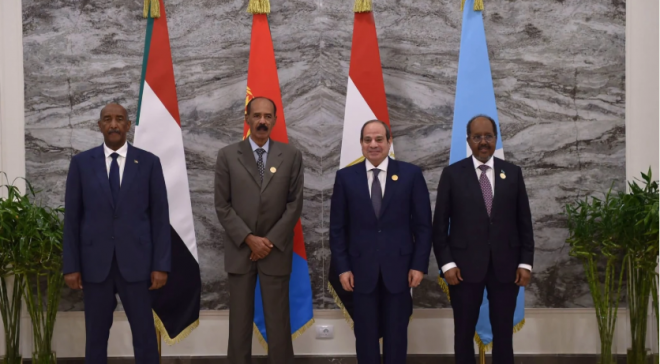
NEW ALAMEIN: “This is not a summit directed against any third party,” former Egyptian assistant foreign minister Hussein Haridy told Arab News as the leaders of Egypt, Eritrea, Sudan and Somalia gathered in New Alamein on Sunday amid mounting tensions in the Horn of Africa.
“Rather, it is a consultative gathering held without a formal agenda,” Haridy said, adding that the meeting was intended to exchange views on developments in the Horn of Africa and Gulf of Aden and their political and economic implications.
Rakha Ahmed Hassan, another former Egyptian assistant foreign minister, said the summit came at a particularly critical moment following the sharp deterioration in relations between Ethiopia and Eritrea.
The two countries severed diplomatic relations on Oct. 1 after Ethiopia ordered the closure of its embassy in Asmara and expelled 10 Eritrean diplomats, accusing Eritrea of supporting armed opposition groups. Eritrea rejected the allegations and responded by cutting diplomatic ties.
Hassan also rejected Ethiopian accusations of Egyptian interference.
“Egypt respects the sovereignty of all nations and does not interfere in internal affairs,” he said, describing the accusations as baseless and unsupported by evidence.
He said Egypt did not oppose development in Africa but objected to actions it considered contrary to international law.
Red Sea security, Hassan added, had become another major concern amid the latest regional tensions.
The leaders of Egypt, Eritrea, Sudan and Somalia met on the sidelines of the 8th African Union Mid-Year Coordination Meeting, hosted by Egypt in New Alamein.
In their joint statement, they placed freedom of navigation, Red Sea security and respect for sovereignty at the heart of the talks.
The leaders affirmed the principle of freedom of navigation and said the security and governance of the Red Sea should remain the responsibility of littoral states.
They also stressed the importance of adhering to international law governing transboundary rivers, including the Nile, particularly the principles of avoiding harm and cooperating through prior notification, consultation and consensus.
The statement rejected unilateral measures that could harm the existing water usage of the two downstream Nile states.
On Sudan, the leaders reaffirmed the country’s unity, sovereignty and territorial integrity and voiced support for its national institutions.
They rejected the establishment of parallel entities and any support for mercenaries, while encouraging the resumption of a Sudanese owned-and-led political process.
The summit also backed Somalia’s counterterrorism efforts and called for the strengthening of state institutions across the country.
The leaders urged regional and international partners to provide adequate, sustainable and predictable funding for the African Union Support and Stabilization Mission in Somalia, or AUSSOM, to support the country’s security transition and the eventual transfer of responsibilities to Somali forces.
More broadly, the summit emphasized respect for the sovereignty, independence and territorial integrity of states in the region, rejected interference in their internal affairs and called for political and peaceful solutions to regional conflicts.
The meeting followed a series of bilateral talks involving Egyptian President Abdel Fattah El-Sisi.
Ahead of the summit, El-Sisi met Eritrean President Isaias Afwerki on the sidelines of the Alamein Africa Business Forum, reaffirming Egypt’s support for Eritrea’s security and stability and stressing respect for its sovereignty and territorial integrity.
El-Sisi also met Sudanese Transitional Sovereignty Council President Gen. Abdel Fattah Al-Burhan on Sunday, reiterating Cairo’s support for Sudan’s unity, sovereignty, territorial integrity and national institutions.
He stressed Egypt’s continued efforts at regional and international levels to advance a political settlement to the Sudanese conflict, end the war and alleviate humanitarian suffering.
Speaking earlier on Sunday at the opening of the AU Mid-Year Coordination Meeting, El-Sisi said every state had the right to development and to benefit from its natural resources, but that this right had to be exercised responsibly and without harming other countries.
He said cooperation over transboundary rivers should be based on international law, consultation, coordination, good-neighborliness and the principle of causing no harm.
Egyptian Foreign Minister Badr Abdelatty also reiterated on Saturday that Egypt had no role in Ethiopia’s internal affairs and did not interfere in the domestic affairs of other countries.
He described Ethiopian accusations against Cairo as attempts to divert attention from domestic developments.
The latest meeting builds on growing coordination among Egypt, Eritrea and Somalia.
At a tripartite summit in Asmara in October 2024, the leaders of the three countries stressed respect for regional sovereignty and territorial integrity and agreed to strengthen coordination on Somalia, Sudan and security in the Red Sea and Bab Al-Mandab Strait.