Ethiopia insists on securing access to Red Sea
-
 Staff Reporter GAROWE ONLINE
- Posted On 07-10-2026, 08:17AM

ADDIS ABABA, Ethiopia — Ethiopian Prime Minister Abiy Ahmed has reiterated his country's determination to secure access to the Red Sea, escalating a longstanding dispute with coastal neighbours over maritime access and regional security.
Abiy made the remarks on Monday after being sworn in for another five-year term as prime minister. Addressing parliament, he said his government would continue efforts to secure a route to the sea for landlocked Ethiopia, describing maritime access as a key national interest.
“Based on the principle of reciprocity, we will work diligently to ensure that Ethiopia obtains access to the sea,” Abiy said, without specifying which country or territory Addis Ababa was seeking to use.
Ethiopia lost its direct access to the sea in 1993 when Eritrea, formerly part of Ethiopia, became independent. Since then, the country has relied heavily on neighbouring states, particularly Djibouti, for the movement of most of its maritime trade.
Abiy's comments come amid worsening relations between Ethiopia and several countries in the region. Addis Ababa has accused Eritrea, Egypt and Sudan of supporting forces opposed to the Ethiopian government, particularly amid renewed tensions surrounding Tigray. The countries have denied the allegations.
Eritrea, meanwhile, has accused Ethiopia of harbouring ambitions to secure maritime access through Eritrean territory. Ethiopia's relations with Egypt and Sudan have also been strained by the Grand Ethiopian Renaissance Dam (GERD), with Cairo and Khartoum raising concerns over the impact of the dam on Nile water flows.
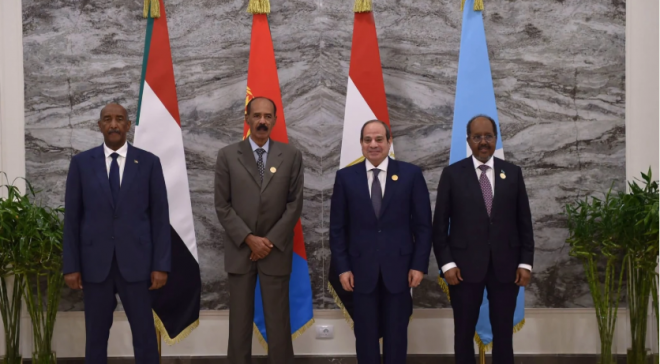
On Sunday, the leaders of Egypt, Eritrea, Somalia and Sudan met in New Alamein, Egypt, where they issued a joint statement saying responsibility for the administration and security of the Red Sea lies with the states bordering its shores. They also warned against measures that could harm Egypt and Sudan's access to Nile waters.
Ethiopia's Foreign Ministry responded the following day, saying any discussion about the Red Sea should take into account Ethiopia's “legitimate interests and longstanding ties” to the waterway.
Somali President Hassan Sheikh Mohamud, who attended the New Alamein summit, congratulated Abiy on his renewed mandate and expressed his desire to strengthen relations between Somalia and Ethiopia and promote peace and stability in the Horn of Africa.
Hassan has previously said Somalia does not oppose Ethiopia obtaining maritime access through Somali territory, but stressed that any arrangement must be negotiated formally between the two governments and respect Somalia's sovereignty.
Abiy's latest remarks come as renewed fighting has been reported in northern Ethiopia, particularly in Tigray, while relations between Ethiopia and Eritrea have entered a particularly tense phase following a diplomatic rupture between the two countries.
The developments have further complicated an already volatile regional landscape, where disputes over maritime access, Red Sea security, Nile waters and armed conflicts are increasingly intertwined.
Ethiopia says it wants to pursue maritime access through dialogue and cooperation, while coastal states have emphasised their sovereign role in determining arrangements concerning the Red Sea.
GAROWE ONLINE