Somalia: Supreme Court rules president, parliament terms expired, orders elections within 90 days
-
 Staff Reporter GAROWE ONLINE
- Posted On 05-11-2026, 12:26PM
MOGADISHU, Somalia — Somalia’s Supreme Court ruled Thursday that the constitutional mandates of the federal parliament, president and government expired in 2026, declaring actions taken by the institutions after the end of their terms unconstitutional and legally invalid.
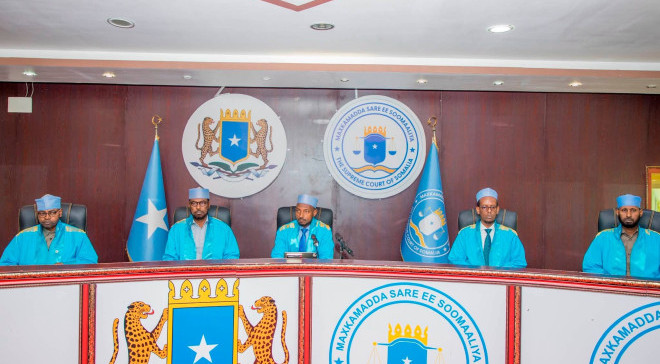
The ruling, issued Nov. 5 by the court’s five-member Constitutional Division, followed a petition filed by former Somali President Sharif Sheikh Ahmed challenging the constitutional amendment process and the legal consequences of changes made to the country’s 2012 Provisional Constitution.
The court said the case involved two main issues: whether the constitutional amendment process complied with Articles 132, 133 and 136 of the 2012 constitution, and whether actions resulting from the amendments, particularly the extension of federal institutions’ mandates, were legally valid.
Court rejects challenge to amendment process
The court rejected the first part of Sharif’s petition, which challenged the constitutionality of the amendment process, ruling that the former president lacked the legal standing to bring the case under Article 86 of the Provisional Constitution.
However, it accepted the second part, which questioned the legality of measures arising from the constitutional changes, particularly the extension of the mandates of elected federal institutions.
In its ruling, the court said constitutional amendments introducing new terms of office must explicitly state whether the changes apply to institutions already in office or only to those elected afterward.
Where an amendment does not clearly address the issue, the new term cannot automatically be applied to sitting institutions, and their original mandates remain in force, the court said.
Applying that interpretation, the court ruled that the constitutional terms of federal institutions remained four years under the 2012 Provisional Constitution because the 2026 amendments did not explicitly state that the new term would apply to institutions already in office.
The court determined that the mandates of both houses of the Federal Parliament expired on April 14, 2026, while President Hassan Sheikh Mohamud’s term ended on May 15, 2026.
It also ruled that the federal government’s mandate expired on April 14, 2026, saying its authority derives from parliament, which has the constitutional power to grant confidence to the government and oversee its activities.
The court said the institutions had no authority to exercise their constitutional and legal powers after their respective mandates expired.
It further declared that all actions taken by the institutions after those dates were unconstitutional, unlawful and null and void.
Court orders political agreement and elections within 90 days
The ruling also addressed the authority of the federal government to remain in office after the expiration of its mandate.
The court said the Federal Government is the only institution constitutionally authorized to oversee a caretaker administration, but stressed that its powers are limited to conducting routine government affairs.
It said the caretaker government cannot take decisions or undertake measures beyond the scope of day-to-day administrative responsibilities.
The Supreme Court ordered all parties concerned with the electoral process to reach a consensus on a workable election framework within 30 days.
It also directed that elections be held within 90 days.
The ruling was issued in Mogadishu on Nov. 5, 2026, and signed by five judges led by Justice Salah Sheikh Ibrahim Dhiblawe.
GAROWE ONLINE