BEYOND PLANTING: How Ethiopia’s Green Legacy Initiative is Reshaping Society, Economy, and Diplomacy
-
 Yohannes Gashama Ethiopian Diplomat, FDRE Consulate General Office, Puntland State of Somalia
- Posted On 17-06-2026, 02:19PM
Introduction: Climate change is one of the most pressing challenges facing the world. Ethiopia, a nation of over 130 million people, remains heavily dependent on rain-fed agriculture, which supports about 85 percent of its population and increases its vulnerability to climate variability.
Against this backdrop, Ethiopia launched the Green Legacy Initiative (GLI) in 2019 under Prime Minister Abiy Ahmed. It is one of his most impactful initiatives, alongside the Dine Initiative, Digital Ethiopia, Urban and Corridor Development, and national peace and reconciliation efforts.
Ethiopia launched its 2026 planting season on 15 June in Bishoftu, targeting 8 billion seedlings for the year as part of its goal to reach 65 billion trees. Seven-Year Planting Progression and Trends: Since its launch in 2019, the Green Legacy Initiative has planted a total of 48 billion seedlings over seven years.
According to the Ethiopian Broadcasting Service, in its first phase (2019), Ethiopia exceeded its target of 4 billion seedlings by planting 4.7 billion. In the second year, the initiative was strengthened despite the challenges of the COVID-19 pandemic. In the third year, it enhanced community participation and national unity. By the fourth year, marking the completion of the first phase, more than 25 billion seedlings had been planted.
The second phase focuses on sustainability and economic value addition. In its first year, emphasis was placed on fruit-bearing and economically valuable species. In the second year, Geographic Information Systems (GIS) were introduced to ensure long-term sustainability. In the third year, Ethiopia set a record by planting 714 million seedlings in a single-day campaign. In the fourth year of this phase, Ethiopia plans to plant over 8 billion seedlings.
The survival rate of planted seedlings has reached 84 percent, and the initiative has contributed to the sequestration of approximately 297 million tons of carbon dioxide. These achievements demonstrate that the Green Legacy Initiative is not only an environmental restoration program but also a driver of economic development, climate resilience, and social cohesion.
Social Impacts
The Third Great National Mobilization: From the battlefield of Adwa that secured sovereignty, to the monumental rise of GERD as a symbol of economic destiny, and now to the Green Legacy Initiative as an environmental triumph—Ethiopia’s story is a continuous arc of national victory, each generation turning struggle into renewal and vision into lasting legacy. The journey reflects not only national success, but a broader African victory: resilience, development, ecological renewal—one shared continental legacy.
Few initiatives in Modern Ethiopian history have mobilized citizens as extensively as the Green Legacy Initiative. Alongside the victory at the Battle of Adwa and the construction of the Grand Ethiopian Renaissance Dam, it stands among the country's greatest collective national undertakings.
As reported by Dialogue Earth — an independent non-profit environmental journalism organization — the initiative has embedded tree planting into Ethiopian culture, with more than 30 million people participating annually. In doing so, it has cultivated a strong culture of civic engagement and mainstreamed environmental awareness into the country’s social fabric.
Since its launch, the initiative has mobilized citizens from all walks of life, including students, governmental institutions, civic and religious associations, the armed forces, diaspora communities, diplomatic missions, international organizations, civil servants, and the private sector.
This broad engagement has strengthened public awareness, fostered a shared sense of responsibility for environmental protection and national development, and elevated conservation into a mainstream social priority.
The GLI as a Force for National Unity: Perhaps the least recognized dimension of the Green Legacy Initiative is its role in strengthening national cohesion. The campaign has created opportunities for Ethiopians from different backgrounds and age groups to participate in a shared national project. Civil servants are often assigned to different parts of the country during planting seasons, fostering new social interactions and a stronger sense of national belonging.
The initiative has created a rare platform where environmental stewardship transcends political, regional, and social divisions. In this respect, the Green Legacy serves not only as an ecological project but also as an instrument of nation-building.
Cultural Shift and Emerging Tradition: A notable cultural shift has also emerged, as tree planting and environmental greening practices have become an evolving national tradition in Ethiopia. Households, hotels, restaurants, government and public institutions, and private organizations are increasingly beautifying their surroundings with ornamental and fruit-bearing plants, turning green spaces into a shared social norm. In this way, environmental beautification has moved beyond policy and become a lived cultural habit embedded in everyday life. The Green Decade continues to represent an evolving Ethiopian tradition, a source of national pride, and a symbol of hope beyond the country.
Economic and Food Security Benefits
The Green Legacy Initiative is often viewed primarily through an environmental lens; however, its significance extends far beyond tree planting. It encompasses a diverse range of seedlings, including forest species, agroforestry plants, fruit trees, fodder crops, and ornamental plants, reflecting both environmental and economic objectives. The GLI has generated significant economic and food security benefits for Ethiopia. It has created over 1.2 million jobs.
Fruit-bearing and agroforestry species such as coffee, avocado, mango, apple, papaya, and tea have strengthened household incomes, improved food availability, and supported rural livelihoods. These crops have also contributed to increased export earnings and foreign exchange generation. Overall, the initiative plays a key role in job creation, income diversification, and Ethiopia’s broader economic transformation.
Environmental Restoration
This diversity demonstrates that the program is designed not only for reforestation but also to advance broader environmental and economic objectives. Beyond tree planting, the initiative contributes to soil and water conservation, restoration of degraded landscapes, reduction of soil erosion, improved watershed management, and biodiversity protection. It also supports the rehabilitation of tributaries feeding major river systems, including the Abbay Basin, thereby strengthening long-term water security.
In addition, it enhances climate resilience. The Green Legacy Initiative has increased national forest cover from 17.2% to 23.6%, underscoring its impact on environmental conservation and the importance of strong community participation during rainy season planting campaigns.
Climate Diplomacy and Recognition
Ethiopia has been actively engaged in climate diplomacy and environmental cooperation through initiatives such as the Green Legacy Initiative and participation in global carbon finance mechanisms. The country has mobilized billions of tree seedlings mainly for domestic reforestation and environmental restoration. At the same time, it has shared experiences, technical knowledge, and climate action practices with neighboring countries in the Horn of Africa.
Green Diplomacy: The Green Legacy Initiative has increasingly become a platform for regional cooperation and integration in environmental action. Ethiopia has also shared its success stories with other countries, contributing to global climate change mitigation efforts. It has shared seedlings, technical expertise, and lessons learned with neighboring countries, including Djibouti, Kenya, Somalia, South Sudan, and Sudan. These countries have joined the efforts, strengthening regional collaboration, with Ethiopia supplying multipurpose seedlings beyond its borders. In Puntland, Somalia alone, 25,000 seedlings have been shared so far and are expected to continue.
Kenyan President William Ruto said he was inspired by Ethiopia’s initiative to plant 15 billion trees in his country and described Prime Minister Abiy Ahmed’s vision as a lasting legacy with strong regional impact for future generations.
Hosting Climate Summits: International organizations, diplomats, environmental experts, and media outlets have highlighted Ethiopia’s large-scale mobilization and climate action. The initiative has strengthened Ethiopia’s standing in global environmental diplomacy and contributed to growing international confidence in the country’s climate leadership.
Ethiopia’s success in the Green Legacy Initiative and its hosting of the African Climate Summit 2 led to its selection as host of COP32 under the UN Framework Convention on Climate Change, reflecting its practical commitment to climate policy implementation and sustainable development.
Recognition and Awards: The Green Legacy Initiative has gained international recognition as a model of large-scale climate action, having planted over 48 billion seedlings and supporting Ethiopia’s goal of a climate-resilient green economy and net-zero emissions by 2050. It aligns with Africa’s climate justice agenda, reflecting long-standing calls for fair climate financing and recognition of the continent’s environmental stewardship. The initiative has received the FAO Award for Sustainable Forest Management and Use. It has also been hailed by the African Union Staff Association as a leading example of climate action in Africa, while the Petersberg Climate Dialogue acknowledged Ethiopia’s climate action model as a best practice, highlighting it as a successful example of locally adapted, high-impact climate action.
Climate Financing Support: Ethiopia is emphasizing that climate challenges require regional rather than purely national responses. In terms of carbon finance, Ethiopia has signed results-based agreements, including an agreement of about $40 million with the World Bank for emission reductions through sustainable land management, and a $75 million climate partnership with Norway to support forest conservation and carbon credit development. These efforts have helped Ethiopia attract climate finance, improve forest cover, and position itself as a regional leader in climate action.
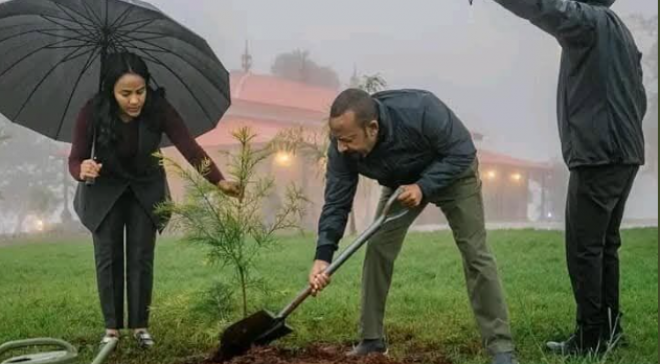
Leaving a Mark: Visiting heads of state, leaders of international organizations, foreign delegations, and celebrities frequently participate in tree-planting activities, making both symbolic and practical contributions to Ethiopia’s environmental transformation.
Among international leaders who have participated in ceremonial tree planting during official visits to Ethiopia are António Guterres, United Nations Secretary-General; William Ruto, President of Kenya; Hassan Sheikh Mohamud, President of Somalia; Giorgia Meloni, Prime Minister of Italy; Narendra Modi, Prime Minister of India; and Workneh Gebeyehu, Secretary-General of IGAD, among many others.
Strategic Actions
To strengthen the effectiveness and sustainability of the Green Legacy Initiative, the government is pursuing four key strategies. First, it is improving seedling survival through digital monitoring and follow-up. Second, it seeks to generate foreign currency from fruit-bearing and other economically valuable species by strengthening agro-industrial value chains. Third, Ethiopia aims to benefit from the global carbon market by introducing policies and legal frameworks that recognize the initiative's contribution to carbon sequestration and emissions reduction, enabling the country to earn carbon credits. Finally, it is strengthening community ownership and the legal protection of planted seedlings. Together, these strategies aim to ensure the initiative's long-term sustainability and economic returns.
Conclusion: The Green Legacy Initiative is no longer merely a tree-planting campaign. It has evolved into one of Ethiopia’s most significant national undertakings, combining environmental restoration, climate action, food security, job creation, diplomacy, and nation-building. It demonstrates how a shared environmental mission can mobilize millions of people around a common purpose while delivering tangible ecological and economic benefits.
As climate change continues to pose an existential challenge to Africa and the world, Ethiopia’s experience offers valuable lessons on the power of collective action. The Green Legacy Initiative shows that environmental stewardship can serve not only as a tool for restoring ecosystems but also as a catalyst for unity, resilience, and sustainable development for generations to come.
Written by: Yohannes Gashama, Ethiopian Diplomat, FDRE Consulate General Office, Puntland State of Somalia