OP-ED: The Constitution, the Ballot, and the Gun: Somalia's Three-Way Crisis
-
 Abdirahman Jeylani Mohamed
- Posted On 07-06-2026, 12:57PM
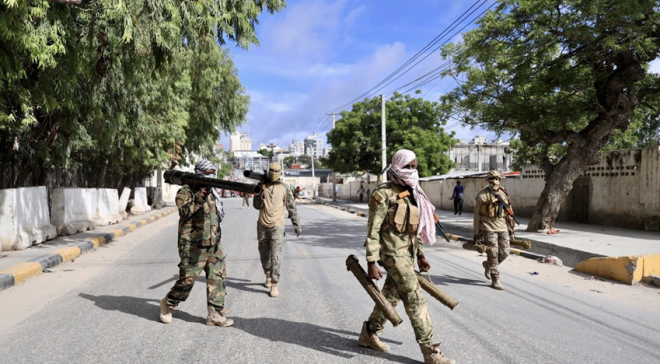
The recent gun battles that shook Mogadishu were not simply another episode of Somalia's chronic instability. They were the first armed manifestation of a constitutional crisis that had been building for more than two years.
At first glance, the confrontation appears to revolve around a familiar issue: elections. The federal government argues that constitutional reforms and electoral changes are necessary to move Somalia toward universal suffrage. The opposition accuses President Hassan Sheikh Mohamud of using constitutional amendments to extend his political mandate and delay elections. Armed clashes erupted after opposition leaders called for protests against what they describe as an unconstitutional extension of power.
But focusing solely on election dates misses the deeper story.
The real struggle is over the nature of the Somali state. Beneath arguments about presidential terms and electoral calendars lies a fundamental conflict over constitutional authority, federalism, and political legitimacy. Somalia is not merely debating who should govern after 2026. It is debated who gets to determine the rules of governance themselves.
That makes the current crisis potentially more dangerous than any election dispute since the collapse of the state in 1991.
The Constitutional Revolution Few Outside Somalia Noticed
The roots of the current confrontation stretch back to the constitutional amendments approved by Somalia's parliament.
For years, Somalia operated under a provisional constitutional framework adopted in 2012. The constitution was intentionally incomplete. It left unresolved some of the most contentious questions in Somali politics, including the balance of power between Mogadishu and federal member states, the structure of elections, and the distribution of executive authority.
Successive governments deferred these issues because political consensus did not exist.
The Hassan Sheikh administration chose a different path.
In March 2026, parliament approved a final package of constitutional amendments concluding a review process that had lasted more than fourteen years. Supporters celebrated the move as a historic milestone in Somalia's state-building journey. Opponents viewed it as a unilateral restructuring of the political system.
The constitutional changes were not technical adjustments.
They represented the most significant redesign of Somalia's political architecture since the adoption of the provisional constitution.
Supporters argue the amendments create a clearer pathway toward direct elections and stronger national institutions. Critics contend they dramatically expand executive authority while weakening the consensus-based mechanisms that have held Somalia's fragile federal system together.
The dispute is therefore not about whether constitutional reform was necessary.
Almost everyone agrees that reform was needed.
The dispute concerns whether such reforms could legitimately be adopted without the consent of key political actors, opposition groups, and several federal member states.
The Election Dispute Is Actually a Legitimacy Dispute
The government's central political project has been the transition from Somalia's indirect clan-based electoral system to a one-person-one-vote model.
For decades, Somali national elections have been conducted through a complex process involving clan delegates, elders, and political bargaining among elites. Most Somalis recognize the system as imperfect. It has frequently produced disputes, allegations of corruption, and recurring constitutional crises.
The government argues that direct elections are essential for democratic legitimacy and state-building. Lawmakers loyal to the administration have framed constitutional reform as a necessary prerequisite for ending the clan-based model and creating a modern democratic state.
Yet the opposition sees a different reality.
Its leaders argue that the government has promised direct elections without establishing the institutional conditions necessary to conduct them. Voter registration remains incomplete. Security conditions remain fragile across large parts of the country. Relations between Mogadishu and key federal member states remain deeply strained. Al-Shabaab continues to threaten large areas of Somalia.
In this view, the promise of direct elections has become politically useful precisely because it justifies delaying the electoral timetable.
The government's supporters describe postponement as a technical necessity.
The opposition describes it as constitutional manipulation.
This disagreement has created a legitimacy vacuum.
Parliament's constitutional mandate expired in April 2026. The president's mandate expired in May. Yet no universally accepted roadmap exists for political transition. The government maintains that constitutional amendments provide legal authority for continuity. The opposition rejects that interpretation entirely.
This distinction is critical.
The crisis is no longer about when elections should happen.
It is about whether the institutions currently governing Somalia possess the constitutional legitimacy to organize those elections.
Why the Armed Clashes Matter
The armed confrontations in Mogadishu fundamentally altered the nature of the crisis.
For months, the dispute had been largely political.
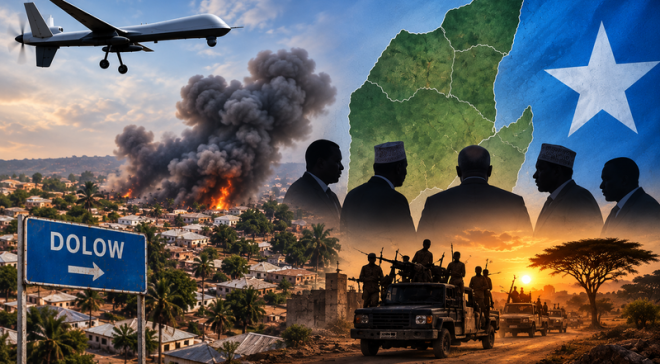
Then, opposition leaders mobilized demonstrations challenging the government's interpretation of the constitution and its continued exercise of power. Before those protests could proceed, government forces and troops aligned with opposition figures exchanged fire in several districts of the capital. Thousands of troops were reportedly deployed. Mortars, armored vehicles, and heavy weapons were used in densely populated neighborhoods. Civilians fled affected areas. Homes were damaged. Residents described scenes reminiscent of earlier periods of instability.
The significance of these clashes extends beyond the casualties.
For the first time since the constitutional dispute escalated, major political actors demonstrated a willingness to use organized armed force in pursuit of political objectives.
This changes the strategic calculations of every actor involved.
Constitutional disputes can be resolved through negotiation.
Armed political confrontations create incentives for escalation.
Once political actors conclude that force can improve their bargaining position, compromise becomes more difficult, and mistrust deepens.
The recent violence, therefore, represents a dangerous transition from constitutional disagreement to coercive politics.
The Return of Armed Politics
Perhaps the most troubling aspect of the crisis is what it reveals about Somalia's political institutions.
A functioning constitutional order provides mechanisms for resolving disputes over elections, executive authority, and constitutional interpretation. Courts adjudicate disagreements. Legislatures negotiate compromises. Political parties compete within accepted rules.
Somalia lacks many of these stabilizing mechanisms.
When disputes emerge, political actors often rely on clan networks, regional administrations, security forces, and armed supporters to advance their positions.
The recent clashes exposed the persistence of this reality.
Former presidents, former prime ministers, federal authorities, regional actors, and clan-based networks all remain capable of mobilizing armed constituencies. The state possesses greater coercive capacity than in previous decades, but political power remains partially decentralized and fragmented.
This means that constitutional disagreements can quickly become security crises.
The institutions designed to manage political conflict remain weaker than the forces capable of escalating it.
Federalism Is the Hidden Battlefield
While attention has focused on Mogadishu, the deeper struggle concerns federalism.
The constitutional amendments have intensified existing tensions between the federal government and several federal member states. Puntland has challenged the constitutional process and withdrawn cooperation with aspects of the federal system. Other regional actors have questioned the legitimacy of reforms adopted without broad consultation.
At its core, federalism in Somalia remains unresolved.
The federal government believes stronger central institutions are necessary to defeat Al-Shabaab, manage national elections, and consolidate state authority.
Regional leaders fear that centralization could recreate the concentration of power that historically fueled conflict and mistrust.
The election dispute is therefore inseparable from the federal question.
Who controls elections ultimately influences who controls the state.
And who controls the state influences the future balance of power between Mogadishu and the regions.
The constitutional amendments are viewed by supporters as state-building.
They are viewed by critics as state centralization.
That difference explains why compromise has become so difficult.
The Al-Shabaab Factor
Every day spent debating constitutional legitimacy is a day not spent confronting Somalia's most dangerous armed threat.
Al-Shabaab remains resilient despite years of military offensives. Security analysts have warned that the electoral dispute is unfolding amid deteriorating security conditions and ongoing insurgent pressure.
Political fragmentation benefits insurgent movements.
It weakens command structures.
It divides political leadership.
It undermines public confidence in government institutions.
Most importantly, it shifts national attention away from counterinsurgency operations and toward elite political competition.
The irony is striking.
The government argues that constitutional reform is necessary to strengthen the state.
Yet the political conflict generated by those reforms risks weakening the state at precisely the moment it faces severe security challenges.
A Crisis of Consensus
The central lesson of Somalia's current confrontation is that state-building cannot rely solely on legal authority.
The government's argument is fundamentally legal.
Parliament approved the constitutional amendments.
The amendments altered the electoral timetable.
Therefore, the government remains legitimate.
The opposition's argument is fundamentally political.
Changes of such magnitude require broad national consensus.
Without that consensus, legality alone is insufficient.
Both arguments contain truth.
And that is precisely why the crisis is so dangerous.
No side can decisively defeat the other politically.
No side can impose a sustainable constitutional order unilaterally.
No side possesses enough legitimacy to govern without the cooperation of the others.
Somalia's political future therefore depends on whether its leaders recognize a simple reality: constitutional durability emerges from consensus, not parliamentary arithmetic alone.
The gunfire heard in Mogadishu this month (3 June 2026) should be understood as a warning.
What began as a disagreement over election procedures has evolved into a struggle over constitutional legitimacy. What began as a constitutional debate has become an armed confrontation. And what began as a dispute over the 2026 elections now threatens the foundations of Somalia's entire political settlement.
The danger is not simply that elections may be delayed.
The danger is that Somalia may lose the consensus that has prevented political disagreements from becoming open conflict.
If that consensus collapses, the country will not be facing an electoral crisis.
It will be facing a crisis of the state itself.
The Author is Abdirahman Jeylani, a Somali journalist based in Mogadishu, a foreign policy commentator and communications specialist. You can reach out to him: jaylaanijr@gmail.com