Opinion: The Gallery Lies of Somalia’s President Hassan Sheikh Mohamud
-
 Abdirahman Jeylani Mohamed
- Posted On 09-07-2026, 11:35AM
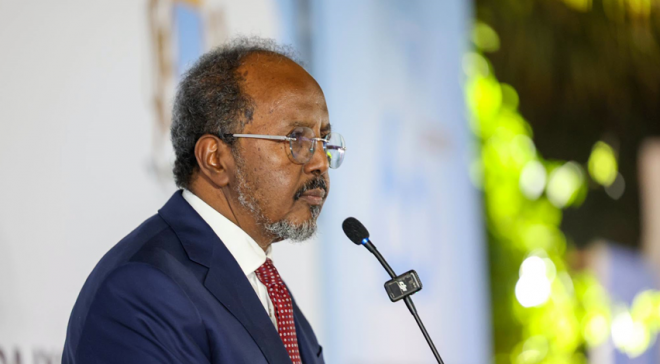
When Hassan Sheikh Mohamud returned to Somalia’s presidency in May 2022, he promised a new chapter of national reconciliation, security reform, institutional rebuilding, and responsible statecraft. His administration presented a vision of a Somalia “at peace with itself” — a country emerging from decades of conflict, strengthening federal institutions, defeating terrorism, and restoring its place in the international community.
Yet halfway through his second term, Somalia’s reality is more complicated than the official narrative suggests. The country has achieved important milestones, including international debt relief in 2024, renewed diplomatic engagement, and progress in some areas of state-building. However, these achievements have been accompanied by deepening political disputes, unresolved federal tensions, continued insecurity, and growing questions about governance.
The central question surrounding President Mohamud’s legacy is not whether his government has achieved successes. It has. The question is whether his leadership has strengthened the foundations of the Somali state or reinforced the political divisions that have historically weakened it.
“Somalia at Peace with Itself”? Federal Tensions Tell Another Story
Growing tensions between Mogadishu and several Federal Member States have challenged President Mohamud’s promise of national unity.
The most serious dispute arose with Puntland over constitutional amendments in 2024. Puntland authorities rejected reforms they argued would centralize power in Mogadishu and announced that they would no longer recognize federal institutions until a broader political agreement was reached.
The dispute reflects Somalia’s unresolved constitutional dilemma: should the Federal Government primarily coordinate among powerful regional administrations, or should it gradually centralize authority to create a stronger national state?
Supporters of Mogadishu argue that constitutional reform is necessary to complete Somalia’s state-building process and create effective national institutions. Critics counter that excessive centralization risks undermining the federal arrangement created after years of political negotiations.
The Somaliland issue has further complicated Somalia’s internal and external politics. Relations between Mogadishu and Hargeisa remain unresolved, while Somaliland’s growing international engagement has increased concerns about Somalia’s territorial integrity. The federal government maintains that recognition and foreign policy issues are national responsibilities, while Somaliland continues to pursue its own diplomatic agenda.
The contradiction is clear: Somalia projects an image of recovery abroad, while internally it continues to struggle over the fundamental question of who controls political authority.
“Somalia at Peace with the World”? A Diplomatic Reality Check
President Mohamud has sought to portray Somalia as a responsible international partner rather than a failed-state narrative of the past. His administration expanded relations with global and regional powers, strengthened diplomatic visibility, and secured major economic achievements such as debt relief.
However, Somalia’s international environment has become increasingly challenging.
A major concern has been the future of international security assistance. Reports in 2026 that the United States was moving to end support for United Nations logistical assistance connected to the African Union Support and Stabilization Mission in Somalia (AUSSOM) raised questions about the sustainability of Somalia’s security transition. The development reflected broader concerns among international partners about Somalia’s ability to build self-sufficient security institutions while facing a resilient Al-Shabaab insurgency.
For Mogadishu, the challenge is significant: after years of international military and financial support, Somalia is under increasing pressure to take greater responsibility for its own security future.
The Somaliland issue has also exposed diplomatic vulnerabilities. Reports of increased Israeli engagement and strategic interest in Somaliland have intensified Mogadishu’s concerns over sovereignty and regional competition. At the same time, the Horn of Africa has become a major arena for geopolitical rivalry due to the strategic importance of the Red Sea and the Gulf of Aden.
Turkey’s expanding role illustrates this new environment. Ankara has become one of Somalia’s closest partners through military training, economic cooperation, and defense agreements, including efforts to strengthen Somalia’s maritime capabilities. Turkey’s support has provided important assistance, but it also demonstrates that Somalia’s strategic space is increasingly shaped by competition among Turkey, Gulf states, Western powers, and other regional actors.
The challenge for Somalia is not simply attracting foreign partners. It is ensuring that external relationships strengthen sovereignty rather than make Somalia a battleground for competing interests.
The “Total War” Against Al-Shabaab: Successes Without Final Victory
President Mohamud’s declaration of “total war” against Al-Shabaab became the defining security policy of his second term.
The initial military campaign achieved significant gains. Somali forces, supported by local clan militias known as Macawisley and international partners, reclaimed several areas in central Somalia. International Crisis Group noted in 2023 that the offensive benefited from local frustration with Al-Shabaab’s taxation, recruitment, and abuses.
The recovery of strategic areas, including Adan Yabaal and surrounding regions, demonstrated that coordinated military and community efforts could challenge Al-Shabaab’s influence.
However, battlefield victories did not become a decisive strategic victory.
Al-Shabaab demonstrated its continued ability to regroup, launch complex attacks, and maintain influence in rural areas. Analysts warned that military operations alone cannot defeat an insurgency without effective governance, local legitimacy, and sustainable security institutions.
The lesson from Somalia’s counterinsurgency is that territory can be captured faster than public trust can be built.
The government’s commitment to fighting terrorism remains a major achievement, but history will judge whether temporary military gains become lasting political stability.
Anti-Corruption Promises and Questions of Accountability
President Mohamud returned to office promising stronger accountability and cleaner governance. His administration highlighted reforms aimed at improving Somalia’s financial credibility and international standing.
However, corruption concerns have continued to affect public confidence.
Critics, including opposition figures and civil society groups, have raised concerns over public land management, government property transactions, and allegations of forced evictions. These issues have become symbols of broader concerns about transparency and state accountability.
The question is not simply whether individual allegations are politically motivated. The deeper issue is whether Somalia has institutions capable of investigating corruption independently, regardless of who holds power.
A government’s credibility depends not only on economic achievements but also on whether citizens believe national resources are protected from political influence.
The Promise of Statesmanship and the Politics of Power
During his 2022 campaign, President Mohamud presented himself as a consensus-builder and elder statesman who would avoid the confrontational politics of previous administrations.
Yet his presidency has faced criticism over disputes involving Jubaland, South West State, Puntland, and political opponents. Critics argue that Mogadishu has attempted to expand federal control at the expense of regional autonomy.
Supporters respond that Somalia’s weak central authority has historically contributed to instability and that a stronger federal government is necessary for national survival.
This debate represents Somalia’s central political challenge: how to build a capable state without recreating excessive centralization.
The Real Test: The 2026 Elections
Ultimately, President Hassan Sheikh Mohamud’s legacy will not be determined only by diplomatic achievements, military campaigns, or international conferences. It will be defined by how Somalia manages the 2026 electoral transition.
The election will test whether Somalia can achieve what previous governments failed to deliver: a peaceful political process based on consensus rather than confrontation.
If President Mohamud oversees an inclusive transition, strengthens federal cooperation, and leaves behind stronger institutions, history may view his presidency as a turning point.
If the period becomes marked by political exclusion, constitutional disputes, or misuse of state power, his legacy may be judged differently.
The challenge facing Hassan Sheikh Mohamud is therefore larger than political victory. It is whether he can prove that Somalia’s state-building project is stronger than any individual leader.
The gallery may show Somalia moving forward. History will judge whether the foundations behind that image are equally strong.
The author is Abdirahman Jeylani Mohamed, a Somali journalist based in Mogadishu, a foreign policy commentator, and communications specialist. You can reach out to him: jaylaanijr@gmail.com