Somalia’s Constitutional Crisis: A Former President Clinging to Power and a Chief Justice Who Found His Voice After Dismissal
-
 GAROWE ONLINE
- Posted On 05-11-2026, 06:25PM
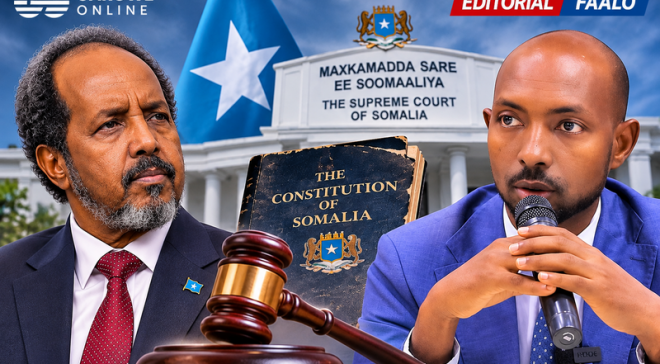
The removal of Somalia’s Supreme Court chief justice has exposed a deeper constitutional crisis, raising questions about presidential authority, judicial independence and the judiciary’s silence during a disputed extension of political mandates.
MOGADISHU — The decision by Somalia’s former president, Hassan Sheikh Mohamud, to dismiss Supreme Court Chief Justice Bashe Yusuf Ahmed has reignited a constitutional dispute that has troubled the country for months, exposing uncomfortable questions about the legitimacy of presidential power, judicial independence and the Supreme Court’s failure to confront earlier constitutional controversies.
On November 4, 2026, Hassan Mohamud removed Bashe Yusuf from office and appointed Ibrahim Idle Suleiman as his replacement. The presidency cited complaints concerning judicial administration but did not publicly establish whether the constitutional procedures required to remove the chief justice had been followed.
A day later, the Supreme Court declared the dismissal unlawful, arguing that Mohamud’s presidential mandate had expired on May 15, 2026, while Parliament’s term had ended on April 14.
But the ruling raised an equally troubling question: Where was the Supreme Court when the executive branch was pushing through controversial constitutional amendments, extending political mandates and facing accusations of undermining the constitutional order?
Under Article 91 of Somalia’s 2012 Provisional Constitution, the president serves a four-year term. Mohamud, elected in May 2022, would therefore have completed that term in May 2026.
However, constitutional amendments adopted in March 2026 extended presidential terms to five years, a move rejected by opposition leaders and the federal member states of Puntland and Jubaland. The federal government maintains that the amendments were lawfully adopted and remain binding.
The dispute over the chief justice’s removal presents a separate constitutional challenge.
Article 90(j) of the 2012 Constitution provides for the appointment of the Supreme Court president through a process involving the Judicial Service Commission, while Article 106 guarantees judicial independence.
The Supreme Court has now invoked Articles 135 and 138 of the amended 2026 Constitution, arguing that removing its chief justice requires the involvement of the Judicial Service Commission and parliamentary approval rather than a unilateral presidential decree.
Yet the timing of the court’s intervention has drawn attention to its own record.
During the months of political confrontation over constitutional amendments and the extension of presidential and parliamentary mandates, the dismissed chief justice did not publicly issue a clear judicial position challenging those developments.
His silence does not necessarily constitute a violation of the law. Courts generally act on cases properly brought before them. Nevertheless, the sudden assertion of constitutional authority following his dismissal raises legitimate questions about judicial consistency, institutional independence and the timing of the ruling.
The Supreme Court said it was considering a constitutional petition filed in October by former President Sharif Sheikh Ahmed challenging the extension of federal mandates.
In its November 5 decision, the court reportedly called for an electoral agreement within 30 days and elections within 90 days. However, it did not invalidate the entire amended constitution, rejecting part of the petition challenging the amendment process.
The confrontation has consequently placed two institutions under scrutiny.
Mohamud faces questions about the constitutional legitimacy of his continued presidency and whether he possesses the authority to remove the head of the judiciary without following the prescribed legal process.
The Supreme Court, meanwhile, faces questions about why it did not address the disputed constitutional changes earlier and why its strongest intervention came only after its own leadership was targeted.
If the earlier extension of presidential power was unconstitutional, judicial silence could not make it lawful. Equally, if the chief justice’s dismissal violated constitutional procedures, the judiciary’s previous failures cannot make that dismissal legitimate.
The central issue is not simply whether Mohamud can remain in office or whether Bashe Yusuf should be reinstated. It is whether Somalia’s constitutional institutions are prepared to uphold the law consistently, including when doing so conflicts with their own political or institutional interests.
For years, Somalia’s constitutional order has been tested by disputes over federal authority, electoral mandates and the separation of powers. The latest confrontation illustrates how fragile that order becomes when constitutional principles are invoked selectively.
A constitution cannot function as an instrument of political convenience, defended when power is threatened and disregarded when power is secure.
Somalia needs a constitutional framework that stands above both the presidency and the judiciary, rather than one that becomes relevant only when their competing interests collide.
Ultimately, the question facing Somalia is not merely who has the legal authority to govern, but whether those entrusted with protecting the Constitution are willing to respect its limits before their own positions are at stake.